Shoppers who watch shoppable video are 225% more likely to add items to cart than visitors who only see static product pages, and brands that put shoppable video on product detail pages report conversion lifts of 30% or more (Bambuser data). Those numbers explain why every major ecommerce stack — from Shopify storefronts to headless commerce builds — is pulling video out of the marketing layer and dropping it directly inside the buying flow.
Shoppable video turns a passive watch into a single-tap purchase. Instead of bouncing the viewer to a product page, the video player carries the catalog, the pricing, the variants, and the add-to-cart action inside the same frame. For developers and product teams, that compresses what used to be three different surfaces — content, product, checkout — into one stream.
In this guide, you will learn what shoppable video is, how it works under the hood, the main types and formats, the benefits and trade-offs, the architecture you need to ship it, real examples from brands using it today, and a step-by-step path to launching your first shoppable video experience.
What Is Shoppable Video?
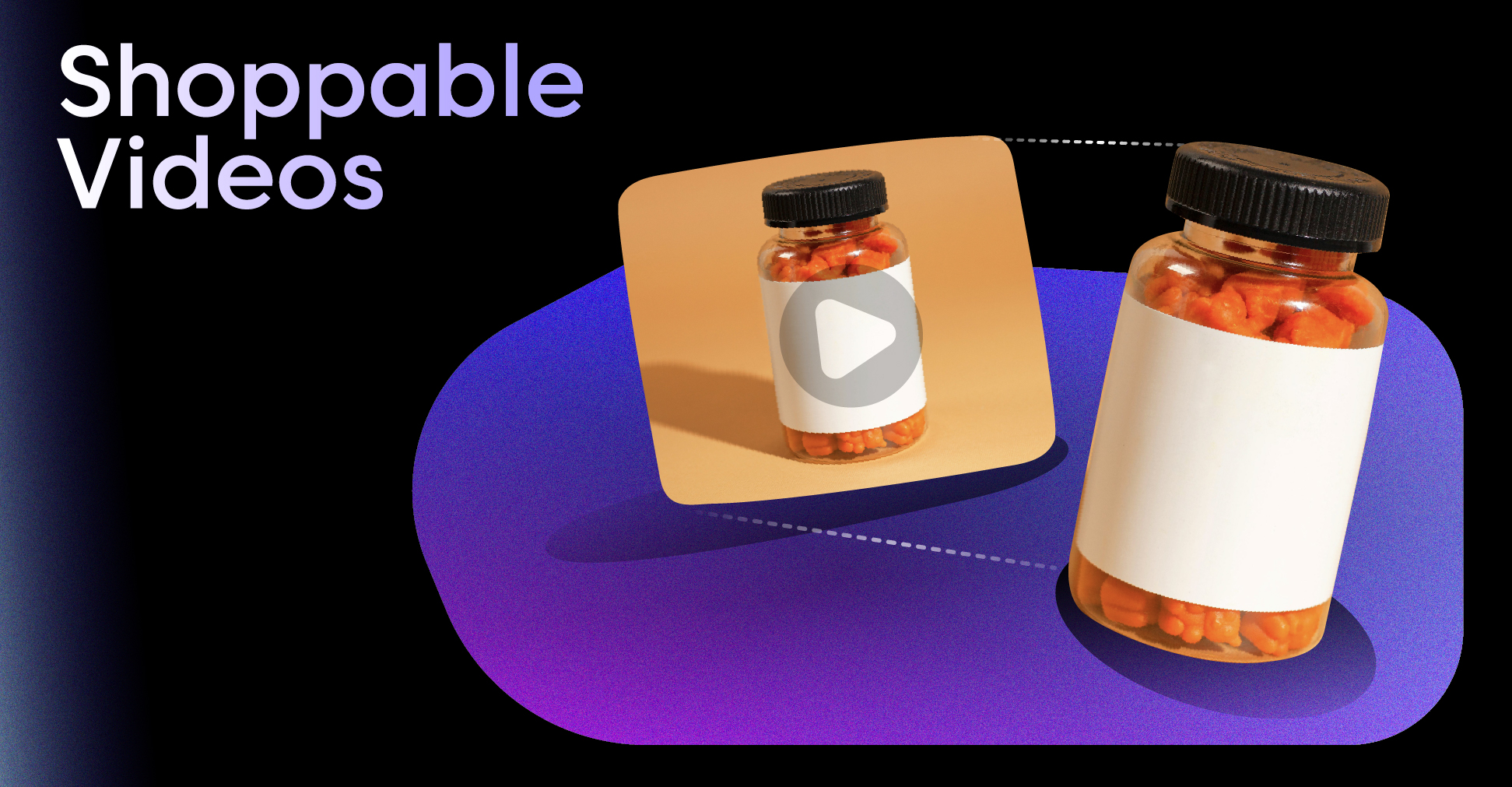
Shoppable video is an interactive video format that embeds clickable product data — pricing, variants, hotspots, and add-to-cart buttons — directly inside the video player, so viewers can buy without leaving the content (definition via TechTarget). Where a traditional product video sends viewers to a separate product page, a shoppable video keeps the catalog, the cart, and the checkout inside the same playback surface.
The format sits at the intersection of video infrastructure and commerce APIs. The player renders the stream, positions interactive overlays at specific timestamps, listens for taps, fetches product data in real time, and writes to the same cart your storefront already uses. Done well, the viewer never feels like they left the video.
Here is how shoppable video compares to other common video formats used in ecommerce:
| Format | Where it lives | Interactivity | Path to purchase |
|---|---|---|---|
| Shoppable video | Storefront, app, social, CTV | Hotspots, product cards, add-to-cart inside the player | Single session, in-video |
| Traditional product video | Product detail page | None (passive playback) | Scroll, click “Add to Cart” |
| Live shopping stream | Storefront, social, app | Live host, chat, real-time product drops | Tap product overlay during stream |
| Pre-roll video ad | Ad networks, social | Click-through to landing page | Multi-page, multi-session |
| Tutorial / explainer video | Blog, YouTube, help center | Description links | External page, often new tab |
The defining attribute is inline conversion. The buying action lives inside the content, not adjacent to it.
How Does Shoppable Video Work?
A shoppable video works because three systems talk to each other in real time: the video player, the product catalog, and the cart or checkout service. The player handles playback and overlays, the catalog provides live pricing and inventory, and the cart records the purchase intent. Most of the engineering work is making sure all three stay in sync.
Here is the typical request flow when a viewer taps a product inside a shoppable video:
- Player loads the video stream — Usually delivered over HLS streaming with adaptive bitrate streaming so playback stays smooth on any connection.
- Player reads time-coded metadata — A JSON or VTT track tells the player which product IDs appear at which timestamps and where to render the hotspot or product card.
- Player calls the product API — As the relevant timestamp approaches, the player fetches live product data (price, variants, stock status) from your commerce backend.
- Viewer taps a product overlay — The player surfaces a product card with image, price, and variant selector. No page navigation happens.
- Player writes to the cart API — On “Add to Cart,” the player calls the same cart endpoint your storefront uses, so the item appears in the shared session cart.
- Checkout continues in-session — The viewer either keeps watching, opens a mini-cart, or transitions to checkout — all without losing the video state.
The faster each of those steps resolves, the better the experience feels. That is why low video latency and fast API response times matter just as much as creative quality.
Types of Shoppable Videos
Shoppable video is not a single format — it is a category of formats that share the same in-video purchase mechanic. The right type depends on whether you are running a storefront, a marketing campaign, or a live event, and whether your buyers are on mobile, web, or connected TV.
Pre-Recorded Shoppable Video
The most common format: a short, pre-produced clip with embedded product tags. These work on product detail pages, category pages, homepage heroes, and email. They are the easiest format to ship because the metadata can be authored offline and the player just plays back the file.
Livestream Shopping
A live host demonstrates products in real time while viewers chat, react, and tap product cards as they appear on screen. Livestream shopping pulls from the same playbook as QVC, but the host might be a creator, an in-house brand expert, or a customer-support agent. It requires low-latency streaming so the chat and product reveals stay in sync with the broadcast.
Social Platform Shoppable Video
Instagram, TikTok, YouTube, and Pinterest all support some version of in-feed shoppable video. Sellers tag products inside posts; viewers tap to see prices, variants, and a checkout link. The integration is platform-managed, which means less engineering work but also less control over the data, the look, and the cart ownership.
User-Generated and Creator-Led Shoppable Video
UGC clips — usually mobile-shot, vertical, and informal — tagged with the brand’s products. Creators record the content, the brand approves and tags it, and the result lives on the storefront, in ads, or in social feeds. Strong for trust and discovery; weak for production polish.
Shoppable Connected TV (Shoppable TV)
The same mechanic on a TV-sized screen, usually with QR codes or remote-driven hotspots since most living-room viewers will not type credit-card numbers with a TV remote. Shoppable CTV requires careful UX choices about which actions happen on the TV and which hand off to a phone.
AI-Generated Shoppable Video
Newer platforms generate shoppable clips automatically from product feeds, repurpose long-form livestream recordings into short shoppable highlights, or auto-tag products inside existing footage using computer vision. This category is moving fast.
A quick comparison of where each format performs best:
| Type | Best for | Production effort | Key infrastructure need |
|---|---|---|---|
| Pre-recorded | PDPs, homepage, email | Medium | Player + product API |
| Livestream | Launches, drops, events | High | Low-latency ingest + chat |
| Social platform | Awareness, top-of-funnel | Low | Platform native tools |
| UGC / creator | Trust, social proof | Low (creator-driven) | Tagging workflow |
| Shoppable CTV | Brand storytelling | High | QR / handoff flow |
| AI-generated | Catalog-scale rollouts | Low (after setup) | Feed integration + tagging AI |
Key Components of a Shoppable Video Architecture
Whether you build shoppable video in-house or buy it from a platform, the same building blocks have to be there. Understanding them helps you scope the work and pick the right video API partner.
Video Player With Overlay Support
The player is the visible layer. It must render the stream reliably across browsers and devices, support custom HTML/CSS overlays on top of the video frame, expose timestamp events your overlay code can listen to, and tolerate ad blockers and slow networks. A modern video player API handles the streaming side and gives you hooks to wire interactivity on top.
Time-Coded Product Metadata
Each shoppable moment needs a record that says “between 0:12 and 0:18, show product SKU 8842 at coordinates (x, y).” That metadata typically lives in a JSON file, a database row, or a sidecar VTT track. The bigger your catalog, the more you will want this to be machine-generated rather than hand-authored.
Real-Time Product API
Pricing and inventory change. If your video shows last week’s price or an out-of-stock SKU, conversions die. The player must hydrate product data on demand from the same product API your storefront calls — not from a static export.
Shared Cart and Checkout
If the video writes to a separate cart, the shopper ends up with two carts and a bad mood. The player must call the same cart endpoint your storefront uses, whether that is Shopify’s AJAX cart, a Commerce Cloud basket service, or a custom headless cart.
Analytics and Attribution
Every product impression, hotspot tap, add-to-cart, and completed checkout must flow into the same event stream your analytics stack already consumes. Without that, you cannot attribute revenue to the moment in the video that triggered it, and you cannot optimize.
Streaming Infrastructure
Behind the player, you need encoding, adaptive bitrate streaming, and a CDN for video streaming to deliver the file fast worldwide. For livestream shopping, you also need ingest (RTMP or SRT), real-time transcoding, and low-latency delivery so the host and the chat stay in sync. This is the layer most teams underestimate.
Benefits of Shoppable Video
The case for shoppable video is mostly conversion math. When you remove the page transition between “interested” and “buy,” the funnel collapses by one full step and the numbers move in your favor.
Higher Conversion Rates
Brands using shoppable video on product detail pages report 30%+ conversion lifts versus static images alone, and shoppable video ads convert at roughly 3.2x the rate of standard video ads (Shopify research). The mechanism is straightforward: shorter path, fewer page loads, fewer chances to bounce.
Higher Add-to-Cart Rates
The 225% lift in add-to-cart rate (versus static pages) shows up almost everywhere shoppable video is measured. Seeing a product in motion plus a one-tap buy button changes the friction profile dramatically.
Higher Average Order Value
Multi-product clips let one piece of content surface several SKUs at once. Viewers who add multiple products from the same video push average order value up — often by 30% or more on pages with product video.
Lower Return Rates
Return rates drop when video sets accurate expectations. A viewer who saw the product in motion before buying is far less likely to be surprised by it on arrival.
Longer Time on Page and Better Engagement
Time on page jumps roughly 88% when product pages include video. Engagement metrics — taps, replays, hover time — also feed back into recommendation engines and on-site search.
Unified Analytics
Because the player writes to the same cart and event stream, you finally get revenue-level attribution for video. You can answer “which 8-second clip drove the most checkout starts?” instead of guessing.
Reusable Content Across Surfaces
The same shoppable clip can ship to PDPs, homepage, email, paid social, and connected TV. Production effort amortizes across channels.
Challenges and Limitations of Shoppable Video
Shoppable video is powerful, but it is not free. Most of the trade-offs are engineering choices you make once and live with.
Page Performance
A poorly built shoppable video player can block the critical rendering path, hurt Core Web Vitals, and tank the SEO of the page it lives on. The fix is lazy loading, asynchronous initialization, and code-splitting the player off the initial bundle.
Catalog Sync Drift
If your platform pulls product data once a day via flat file, every video risks showing wrong prices or out-of-stock items for hours. Real-time API-based hydration is the only way to avoid drift at scale.
Mobile UX
Most shoppable video views happen on a phone. Vertical aspect ratio, thumb-reachable hotspots, large tap targets, and fast checkout all matter more than on desktop. Treat mobile as the primary target, not the responsive afterthought.
Cart Ownership and Headless Stacks
In a headless or composable commerce stack, “the cart” can mean three different services. The shoppable video player has to write to the canonical one. Get that wrong and you will be debugging duplicate carts for weeks.
Content Operations Workload
Tagging products at the right timestamps takes time. Without an authoring tool and a clear workflow, the team that owns content and the team that owns the product feed will be in each other’s way.
Attribution Across Channels
Once the same clip lives on PDPs, social, email, and CTV, you need consistent event IDs and a clean attribution model. Otherwise the data turns into a pile of channel-specific dashboards that do not reconcile.
The first half of this guide covered what shoppable video is, how it works, and the trade-offs you take on when you ship it. The second half is about how you actually build it — what to wire up first, the best practices that separate good experiences from bad ones, the platforms in the market, and how to decide whether shoppable video makes sense for your team right now.
How to Build a Shoppable Video Experience
If you are building shoppable video from scratch, the work breaks down into a streaming layer, an overlay layer, a commerce layer, and an analytics layer. You can ship a working version in a sprint or two if you already have video infrastructure in place.
Step 1: Pick Your Streaming Stack
You need somewhere to encode, store, and deliver the video. For pre-recorded clips, that means a video hosting API with HLS output and global CDN delivery. For livestream shopping, you need RTMP or SRT ingest, real-time transcoding, and low-latency delivery. Building this yourself is months of work; using a streaming API like LiveAPI compresses it to a few API calls. LiveAPI handles 4K ingest, instant encoding, adaptive bitrate output, and delivery across Akamai, Cloudflare, and Fastly — which is the infrastructure layer shoppable video sits on top of.
Step 2: Define Your Product Metadata Schema
Decide how you will store time-coded product data. A simple starting point is a JSON file per video with this shape:
{
  "video_id": "spring-lookbook-01",
  "tags": [
    {
      "sku": "dress-8842",
      "start": 1.2,
      "end": 6.8,
      "position": { "x": 0.42, "y": 0.55 }
    },
    {
      "sku": "shoes-5511",
      "start": 4.0,
      "end": 12.0,
      "position": { "x": 0.28, "y": 0.81 }
    }
  ]
}
Coordinates are normalized (0–1) so they scale to any player size. Once you have one or two videos working, you will want a CMS or admin UI for tagging — hand-editing JSON does not survive contact with a real content team.
Step 3: Embed the Player With Overlay Hooks
Drop the player into your page or app and wire it to the metadata. Most modern players expose a timeupdate event you can listen to:
player.on('timeupdate', () => {
  const t = player.currentTime();
  const visibleTags = metadata.tags.filter(
    tag => t >= tag.start && t <= tag.end
  );
  renderHotspots(visibleTags);
});
Render the hotspots as absolutely positioned elements on top of the video. On tap, open a product card with live pricing fetched from your commerce API.
Step 4: Wire the Cart API
The product card’s “Add to Cart” button should call the same cart endpoint your storefront uses. For a Shopify store, that is /cart/add.js. For a headless build, it is your cart service. The key rule: one shared cart per session, no duplicates.
Step 5: Add Analytics Events
Emit events for every meaningful interaction — video_play, product_impression, product_card_open, add_to_cart_from_video, video_complete. Include the video ID, the SKU, and the timestamp on every event. That gives you the data to attribute revenue to specific moments in specific clips.
Step 6: Test on Mobile First
Run the full flow on a real phone over a 4G connection. Watch for slow product card loads, hotspots that overlap the player’s native controls, and any moment where the viewer has to leave the video to complete a purchase. Fix those before you launch.
Step 7: Launch, Measure, Iterate
Start with one product detail page or one homepage hero. Compare conversion, AOV, and time-on-page to a control. Once the lift is clear, expand to category pages, email, and paid social. The same clip can ship to all of them.
Best Practices for Shoppable Video
The brands getting the biggest lift from shoppable video tend to do the same handful of things well. None of them are hard — but skipping any one of them costs conversions.
- Lead with the product in the first 3 seconds. Viewers decide whether to watch or scroll fast. Show the SKU on screen quickly so the hotspot has somewhere to anchor.
- Tag every product the moment it appears. Do not wait for a “shop” moment at the end. People buy when they see the thing they want, not later.
- Keep clips short. 15–60 seconds is the sweet spot for storefront placements. Longer livestreams are fine, but cut them into short, shoppable highlights afterward.
- Use vertical video for mobile placements. Horizontal video on a phone wastes most of the screen.
- Make the product card load instantly. If the card takes more than 200ms to appear after a tap, you have lost the impulse purchase.
- Share the cart with the storefront. Never spin up a separate cart service for the video player.
- Lazy-load the player. Initialize it only when the video section enters the viewport. The page should not pay the cost of loading the player unless the viewer is going to see it.
- Track everything with the same event taxonomy. Use the same
product_id,video_id, andsession_idyour storefront analytics use, so the data joins cleanly. - Repurpose long-form into short-form. Livestream recordings, product demos, and brand stories can be cut into multiple shoppable clips for different surfaces.
- Test the checkout from inside the video. The single biggest source of lost conversions is a broken handoff between the video player and the cart.
Top Shoppable Video Platforms
If you do not want to build the overlay and tagging layer yourself, several platforms handle the commerce-side stack. Most of them assume you already have video infrastructure (or they bundle it).
- Tolstoy — AI-driven, no-code shoppable video widgets. Strong for Shopify stores that want fast rollout.
- Firework — Embedded short-form video and livestream commerce. Used heavily by enterprise retailers.
- Bambuser — Live shopping focus, deep enterprise integrations, used by global beauty and apparel brands.
- Videowise — End-to-end shoppable video for Shopify, including UGC ingestion and product tagging.
- Smartzer — Interactive video overlays with strong analytics and a flexible player.
- Vimeo / JW Player — General video platforms that have added shoppable features on top of their players.
- Quinn.Live, VideoWise, CommentSold — Niche flavors of social commerce and livestream shopping.
The platforms compete on the overlay layer, the tagging UX, the integrations, and the analytics. None of them remove the need for a strong streaming layer underneath — they assume you have one or supply a basic one that may not scale. If you want full control of the streaming side, plug a dedicated live streaming API into the platform of your choice.
Shoppable Video Examples
A few examples from brands that have publicly reported results worth paying attention to:
- Ray-Ban reported a 101.47% conversion-rate lift after replacing static PDP imagery with shoppable video, mostly by removing page-transition friction in the path to purchase.
- Kappahl saw 36.54% conversion rates among livestream viewers who engaged with in-show polls — a strong signal for blending interactivity with shoppable mechanics.
- Matas averaged 15% engagement rates and 14-minute view times on its livestream commerce events.
- Fenty Beauty uses pre-recorded testimonial videos with embedded product tags directly on its product pages.
- LSKD layers shoppable video into its social channels and routes traffic back to a fully tagged storefront experience.
- Thrive Causemetics runs shoppable video built around user-generated content from real customers.
The pattern across all of them: the video is not a separate marketing asset; it is a buying surface inside the storefront.
Is Shoppable Video Right for Your Brand?
Shoppable video is not a fit for every catalog. Use this checklist to decide whether to invest now or wait.
- You sell visually-driven products (apparel, beauty, home, food, accessories) where seeing the product in motion changes the buying decision.
- You have or can produce short-form video content — internally, through creators, or via UGC.
- You can integrate with your existing cart and product APIs. A shoppable player that does not talk to your real catalog is theater.
- Your traffic is mobile-heavy. Shoppable video shines on phones; the lift is smaller on desktop.
- You have analytics in place to measure conversion, AOV, and engagement. Without measurement, you cannot prove the lift.
- You can commit to ongoing content production. One shoppable video on a homepage does not move the needle; an always-on content engine does.
If five or more of those apply, shoppable video will likely pay back. If fewer than three apply, fix those gaps first and revisit later.
Shoppable Video FAQ
What is the difference between shoppable video and live shopping?
Shoppable video is the broader category — any video with embedded purchase mechanics. Live shopping is one type of shoppable video, specifically a real-time broadcast with a host, chat, and live product drops. All live shopping is shoppable video, but most shoppable video is pre-recorded.
Does shoppable video hurt page speed?
It can if the player is implemented poorly. A well-built player loads asynchronously, lazy-initializes when the video section enters the viewport, and adds under 50ms to page load. If your shoppable video provider cannot tell you their Core Web Vitals impact, ask harder.
How long should a shoppable video be?
For storefront placements (PDPs, homepage, email), 15–60 seconds is the sweet spot. Livestream events run 30–60 minutes but are usually re-cut into 30–90 second shoppable highlights afterward. The right length is whatever it takes to show the product and not a second more.
Can shoppable video work with headless commerce?
Yes. A good shoppable video player exposes the same REST or GraphQL hooks your headless storefront uses. The player calls your existing product and cart APIs — it does not need its own. If a vendor’s player only works with one specific commerce platform, that is a flag.
How do I add shoppable video to Shopify?
Most Shopify stores use a third-party app (Videowise, Tolstoy, Firework, etc.) that drops a player into the theme and writes to Shopify’s AJAX cart. If you have a custom theme or a headless Shopify build, you can embed a streaming player directly and wire the overlay layer yourself.
What metrics should I track for shoppable video?
Track at least: video play rate, completion rate, product card open rate, add-to-cart-from-video rate, conversion rate, average order value, and revenue per video view. Compare against a non-video control on the same page.
Do I need a separate video platform for shoppable video?
You need video infrastructure underneath — encoding, storage, CDN delivery, an embeddable player. You do not necessarily need a “shoppable video platform” if you have engineering capacity to build the overlay and tagging layer on top of a general video SDK. Most brands buy the overlay layer and bring their own streaming.
Can shoppable video be indexed by search engines?
The video itself can be indexed if you use VideoObject schema markup, host the file on a crawlable URL, and provide a transcript. The shoppable overlays are not SEO-relevant — they are interactivity layers on top of the video — but they do not block indexing if implemented as standard DOM elements.
Shoppable video collapses three surfaces — content, product, checkout — into one. The brands that get the biggest lifts treat it like a buying surface, not a marketing experiment: they invest in the streaming layer, share the cart with the storefront, tag aggressively, and measure conversion the same way they measure every other page. The technology is no longer experimental, and the build is no longer months of custom work.
If you are ready to put shoppable video into your storefront, you need streaming infrastructure that does not become the bottleneck. LiveAPI gives you 4K ingest, instant encoding, adaptive bitrate output, and global CDN delivery through a single API — the layer that sits beneath every shoppable video experience. Get started with LiveAPI and ship your first shoppable video sprint instead of your first shoppable video roadmap.