Vimeo OTT powers more than 9,300 branded channels with 13 million+ active subscribers and over $429 million in annual creator revenue, according to Vimeo’s official OTT page. If you’ve ever paid a monthly fee to watch a niche fitness service, a documentary club, or a wrestling federation’s app, there’s a good chance you were already a Vimeo OTT customer without knowing it.
This guide explains what Vimeo OTT is, how it works, what it costs, and where it fits in the broader video infrastructure stack. We’ll cover the platform’s monetization models, supported devices, pricing tiers, API capabilities, advantages, and limitations — plus when a developer-first alternative makes more sense than a packaged solution.
What Is Vimeo OTT?
Vimeo OTT is a hosted video subscription platform that lets creators, media brands, and businesses launch their own branded streaming service across web, mobile, and connected TV apps. It packages video hosting, payment processing, content management, analytics, and multi-device app delivery into one product, so operators can sell subscriptions, rentals, or pay-per-view access without building infrastructure from scratch.
The product was originally called VHX, a startup Vimeo acquired in May 2016. In April 2025, Vimeo rebranded the product line from “Vimeo OTT” to “Vimeo Streaming,” though most of the industry — and most search traffic — still uses the original name. On credit card statements you’ll often see the legacy entity VHX dba Vimeo OTT as the merchant of record.
At its core, Vimeo OTT belongs to a broader category of OTT platform tools that deliver video directly to viewers over the open internet, bypassing traditional cable and satellite distribution. The “OTT” stands for over-the-top, meaning content goes “over the top” of legacy distributors.
| Attribute | Vimeo OTT (Vimeo Streaming) |
|---|---|
| Category | All-in-one video subscription platform |
| Launched | 2016 (as Vimeo OTT, after VHX acquisition) |
| Rebranded | April 2025 → “Vimeo Streaming” |
| Pricing model | Per-active-subscriber + revenue share |
| Starter price | $1 per subscriber/month + 10% on one-time sales |
| Enterprise price | Custom quote (API + DRM + branded apps) |
| Supported devices | iOS, Android, Apple TV, Roku, Fire TV, Xbox, Smart TVs |
| Monetization | SVOD, TVOD, AVOD, FVOD, PPV |
| API access | Enterprise tier only (legacy VHX API) |
| Best for | Creators selling subscriptions to a defined audience |
A Brief History: VHX → Vimeo OTT → Vimeo Streaming
Understanding the rebrand timeline helps make sense of the documentation, billing statements, and API endpoints you’ll encounter.
- 2013: VHX launches as a niche platform for filmmakers to sell digital downloads, then pivots to subscription channels.
- May 2016: Vimeo acquires VHX. The product becomes “Vimeo OTT” but keeps the
dev.vhx.tvAPI domain and merchant name. - 2017–2024: Vimeo expands the platform with branded apps, AVOD, live linear channels, and analytics.
- April 2025: Vimeo officially rebrands the product to Vimeo Streaming, though all developer documentation and most third-party reviews still reference “Vimeo OTT.”
- September 2025: Italian holding company Bending Spoons announces a $1.38B acquisition of Vimeo.
- November 24, 2025: Deal closes. Vimeo is delisted from Nasdaq.
- January 20, 2026: Vimeo lays off the majority of its staff under Bending Spoons ownership, leading to questions across the creator community about long-term product direction.
The history matters because it explains the platform’s mixed naming, the legacy API surface, and the recent uncertainty that has pushed many operators to evaluate alternative video on demand platforms.
How Does Vimeo OTT Work?
Vimeo OTT abstracts the technical layers of running a streaming service into a handful of dashboard workflows and APIs. Here’s the end-to-end flow from your perspective as the operator and from the viewer’s perspective.
1. Content Ingestion and Encoding
You upload source video files (or import from Google Drive, Dropbox, or Frame.io) through the Vimeo OTT dashboard or the API. Vimeo automatically transcodes the files into multiple renditions for adaptive bitrate streaming, which delivers the right quality based on each viewer’s connection speed. This is the same approach used by any modern video transcoding API, but here it happens implicitly behind the platform.
2. Catalog Management
You organize content into Products (subscription tiers, one-time rentals, or single purchases) and Collections (series, seasons, episodes, playlists, or movie extras). Metadata, thumbnails, trailers, and search tags are managed through the same dashboard.
3. Branded Storefront and Apps
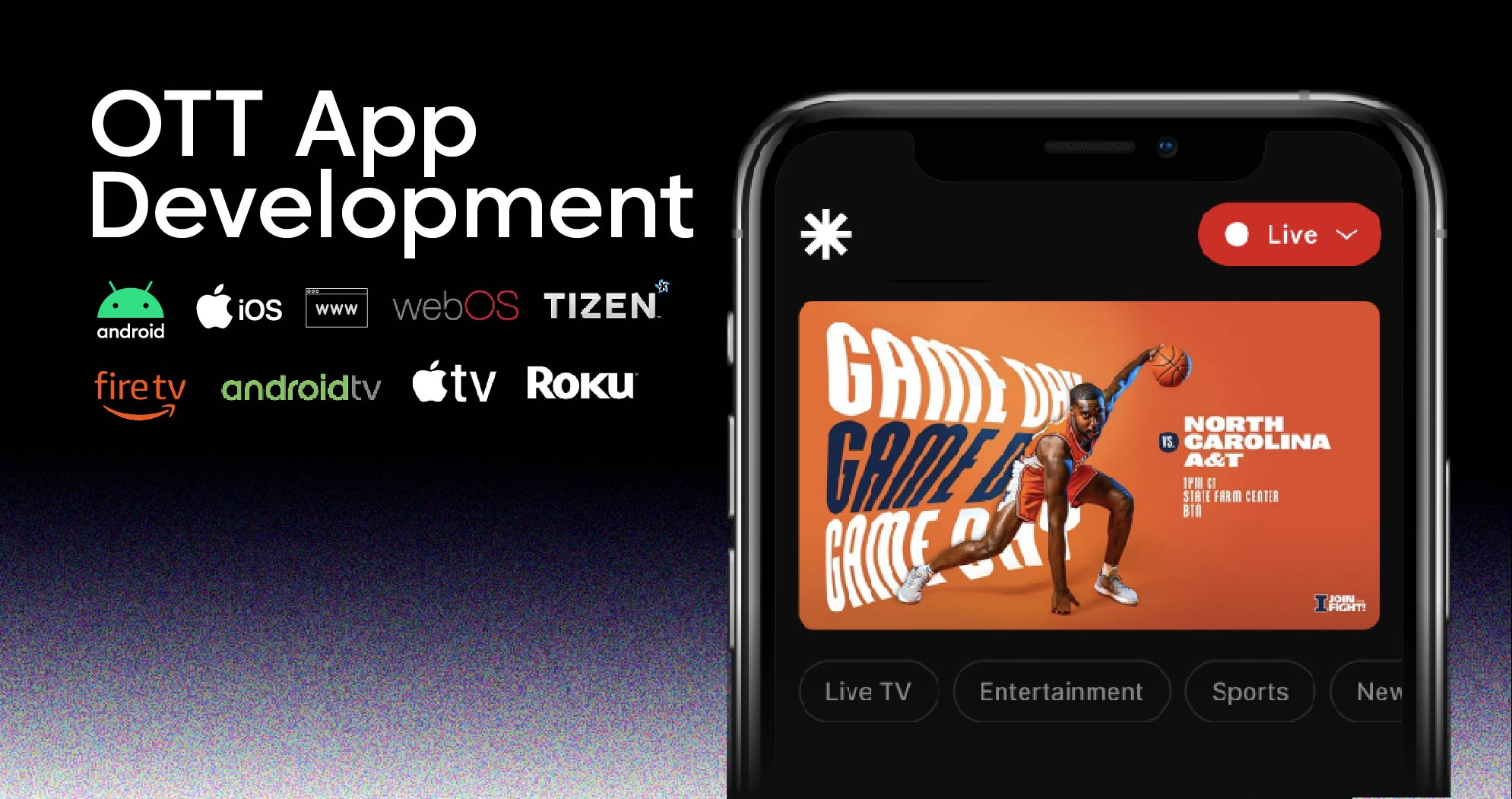
Vimeo OTT generates a white-label website with a custom domain, plus optional branded apps for iOS, Android, Apple TV, Roku, Fire TV, Xbox, Samsung Tizen, LG webOS, Vizio, and Android TV. The Starter tier includes the web storefront and select TV apps; the Enterprise tier unlocks fully branded apps across all platforms.
4. Authentication and Authorization
The platform handles signups, logins, password resets, and access control. Vimeo OTT issues authorizations — short-lived tokens that determine which products and collections a customer can stream. Authorization is managed automatically based on subscription status, rental window, or one-time purchase.
5. Payment Processing
Vimeo OTT uses Stripe for credit card payments and Apple/Google in-app purchases for mobile and TV subscriptions. The platform supports 100+ currencies, recurring billing, free trials, coupons, gift cards, and tax handling.
6. Video Playback
Authenticated viewers stream content via Vimeo’s HTML5 player and native SDKs. Video is delivered using HTTP-based HLS on a proprietary CDN (not Akamai or Fastly). Enterprise customers can layer multi-DRM protection from Widevine, FairPlay, and PlayReady.
7. Analytics and Reporting
Operators get dashboards for subscriber growth, churn, revenue, watch time, retention, and content performance. Enterprise plans add custom reports and a direct data export.
Vimeo OTT Pricing: Plans and What You’ll Actually Pay
Pricing is one of the most-searched topics for the platform, and also one of the most misunderstood. Vimeo OTT runs on a revenue-share model rather than a flat monthly fee, which sounds friendly at small scale but compounds quickly as you grow.
Vimeo OTT Pricing at a Glance
| Plan | Monthly fee | Per-subscriber fee | Transaction fee | API access | Branded apps |
|---|---|---|---|---|---|
| Starter | $0 | $1 per active subscriber | 10% + $0.50 per one-time sale | No | Web + select TV apps |
| Enterprise | Custom quote | Custom (often blended) | Negotiable | Yes (VHX API) | All platforms |
Starter Plan
The Starter tier has no upfront cost. You pay $1 per active monthly subscriber for SVOD revenue, plus 10% of the sale price plus $0.50 per transaction on one-time purchases or rentals.
That math is fine at 100 subscribers ($100/month). At 5,000 subscribers you’re paying $5,000/month — and at that point you’ve outgrown most of the included features and need to negotiate Enterprise pricing anyway. This pay-as-you-grow structure is convenient at launch but can become more expensive than a flat-fee or usage-based video hosting API as your audience scales.
Enterprise Plan
The Enterprise plan unlocks the features serious operators actually need:
- 60 TB of monthly bandwidth and 200 upload hours
- Full HD/1080p delivery (Starter is capped at lower resolutions)
- Branded apps across all 10+ supported devices
- 24/7 live linear channels for scheduled broadcasts
- Multi-DRM support (Widevine, FairPlay, PlayReady)
- API and SSO access for custom integrations
- Dedicated account manager and migration assistance
- Advanced analytics and custom reporting
Pricing for the Enterprise plan is custom and quote-based, with starting points reported in the $1,000+/month range for API access alone. There are no published rates — you have to talk to a sales rep.
For a side-by-side breakdown of how this compares to other platforms, see our guide on video hosting costs.
Key Features of Vimeo OTT
Vimeo OTT’s feature set is designed to compress the launch timeline for a subscription video service. These are the capabilities that matter most for operators evaluating the platform.
White-Label Branding
The web storefront, app icons, splash screens, in-app navigation, player skins, and email templates can all be customized with your brand colors, logo, and typography. Vimeo’s branding stays out of the customer experience.
Adaptive Streaming Player
The HTML5 player auto-selects the best video rendition based on the viewer’s bandwidth and device, similar to any modern live streaming SDK. It supports subtitles, closed captions, chapter markers, and viewer-controlled playback speed.
Multi-Platform Apps
Enterprise customers get native apps for iOS, Android, Apple TV, Android TV, Roku, Amazon Fire TV, Xbox, Samsung Tizen, LG webOS, and Vizio. The apps are submitted under your brand to each platform’s app store.
Subscriber and Content Management
A unified dashboard lets you manage products, collections, subscribers, transactions, refunds, and access permissions. Bulk operations and CSV exports are available for larger libraries.
Live Streaming and Live Linear
Enterprise plans support both event-based live streams and 24/7 live linear channels (think continuous “TV-style” programming). Live streams can be archived as VOD automatically after the event.
Analytics Dashboard
Subscriber retention, lifetime value (LTV), churn rate, MRR, content performance, and viewer engagement metrics are tracked out of the box. You can identify which titles drive subscriptions and which lead to cancellations.
Vimeo OTT API
Enterprise customers get access to the VHX-era REST API at dev.vhx.tv. The API follows the HAL (Hypertext Application Language) protocol, with _links and _embedded resource navigation. It exposes products, customers, videos, collections, authorizations, and analytics endpoints.
# Example: List products via the Vimeo OTT API
curl -X GET "https://api.vhx.tv/products" \
  -u "your_api_key:" \
  -H "Accept: application/json"
The API is sufficient for basic integrations but is read-heavy and lacks the granular control developers expect from a modern video API.
Vimeo OTT Monetization Models
The platform supports five distinct ways to monetize content. Most operators run a primary model plus one or two secondary models in the same channel.
| Model | What it is | When to use it |
|---|---|---|
| SVOD | Subscription Video on Demand — recurring monthly or annual fee for unlimited access | Long-form catalog, niche enthusiasts, evergreen content |
| TVOD | Transactional VOD — pay-per-view rentals or purchases of individual titles | New releases, one-off documentaries, limited-time events |
| AVOD | Advertising VOD — free for viewers, monetized through ads | Reach-driven brands, lighter content, free tier on a hybrid model |
| FVOD | Free VOD — free access in exchange for signup (email capture) | Lead-gen funnels, trial libraries, marketing arms of larger brands |
| PPV | Pay-per-view — single-event purchase for live or scheduled streams | Sports, concerts, premieres, conferences |
For a deeper look at how these models compare, see our breakdown of AVOD vs SVOD and our full guide to OTT video monetization.
Advantages of Vimeo OTT
Fast Time to Launch
You can stand up a branded subscription service in days, not months. The dashboard handles everything from upload to checkout, so a non-technical operator can ship without engineering.
True White-Label Experience
Unlike YouTube channel pages or many free hosting tiers, Vimeo OTT never shows Vimeo branding to your subscribers. The storefront and apps look entirely like your own product.
Built-In Payment and Tax Handling
Stripe integration, multi-currency, tax calculation, and in-app purchase support work out of the box. For most operators, this alone offsets weeks of integration work.
Multi-Device App Distribution
Native TV apps for Roku, Apple TV, Fire TV, Android TV, and the major smart TV platforms are notoriously difficult to build and certify. Vimeo OTT submits and maintains them on your behalf at the Enterprise tier.
Multiple Monetization Models in One Platform
Switching from SVOD to a hybrid SVOD/AVOD or adding PPV events doesn’t require a re-platform. Mix models at the product level.
Disadvantages and Limitations of Vimeo OTT
Pricing Scales With Success
The $1-per-subscriber model penalizes growth. Once you cross a few thousand subscribers, the platform fee becomes one of your largest line items. Operators frequently move off Vimeo OTT not because the platform stops working but because the economics stop working.
Limited API Surface
The VHX API is sufficient for basic catalog and customer reads but lacks the depth of a developer-first stack. Custom paywalls, complex authentication flows, programmatic transcoding, and granular DRM controls require workarounds.
Proprietary CDN
Vimeo OTT delivers video over its own internally operated CDN rather than partnering with major networks. Operators with global audiences sometimes report inconsistent delivery in regions where a dedicated CDN for video streaming would perform better.
Geographic Playback Restrictions
Content cannot be played back in China and Indonesia, which can be a hard blocker for operators with audiences in those markets.
Uncertain Product Roadmap
Following the Bending Spoons acquisition and the January 2026 layoffs, many operators are questioning the platform’s investment in new features. The April 2025 rebrand to “Vimeo Streaming” also introduced friction across documentation and tooling.
Lock-In Risk
Subscriber data, billing relationships, and app store identities are all tied to Vimeo’s infrastructure. Migrating to another platform is possible but typically requires building a parallel system, running both in production for a transition window, and absorbing some churn.
If you’ve made it this far, you’re probably weighing whether Vimeo OTT is the right home for your video product — or whether a more flexible approach makes sense. The next sections shift from evaluation to action.
How to Get Started with Vimeo OTT
If you decide the trade-offs make sense, here’s the typical onboarding path.
- Sign up for the Starter plan at vimeo.com/ott. No credit card is required to create the account.
- Configure your storefront: domain, branding, navigation, and pricing tiers.
- Upload your initial catalog and organize it into Products and Collections.
- Connect Stripe for credit card processing and configure tax settings.
- Launch a soft beta with 50–200 trusted subscribers to test the experience.
- Submit branded apps (Enterprise) or use the bundled web storefront and limited TV apps (Starter).
- Migrate or import existing subscribers if you’re switching from another platform. Enterprise plans include migration assistance.
- Set up analytics dashboards and define your north-star metrics: MRR, churn, average watch time, and LTV.
Vimeo OTT API: What You Can Build
The VHX API gives Enterprise customers programmatic access to most platform resources. You can:
- Create and update products, collections, and videos
- List, create, and manage customers
- Issue and revoke authorizations
- Pull analytics events
- Build custom player experiences using the embed player API
What the API does not do well: programmatic transcoding (you can’t pass arbitrary encoding ladders), low-level CDN cache control, custom DRM integrations outside Vimeo’s defaults, or live streaming ingestion from arbitrary RTMP/SRT sources without going through the dashboard. For teams that need that level of control, a dedicated live streaming API is usually a better fit.
Vimeo OTT vs. Alternatives
The “vimeo ott alternatives” search term has grown steadily since the 2025 rebrand, and the alternative landscape has matured. Here’s how the platform stacks up against the most common competitors and architectural patterns.
| Solution | Model | Best for | Trade-off vs. Vimeo OTT |
|---|---|---|---|
| Uscreen | Hosted SaaS | Creators, fitness, education | Stronger community + email tools, similar pricing curve |
| Dacast | Hosted SaaS | Live events, broadcasters | Akamai CDN, China playback, less polished apps |
| Brightcove | Enterprise SaaS | Large media brands | More powerful, much more expensive |
| Muvi | Hosted SaaS | DIY operators | Lower entry price, less mature mobile apps |
| JW Player | Hybrid | Publishers, ad-supported | AVOD-first, deeper player customization |
| Build with a video API | Developer-first | Engineering-led teams | Maximum control, you own the UX and economics |
The “build with an API” option deserves its own section. Teams that go that route typically use a video infrastructure stack (ingest, transcode, hosting, delivery, analytics) as building blocks and assemble the OTT experience themselves. For a step-by-step approach, see our guide on how to build a streaming service and the companion article on how to build an on-demand video platform.
This is where LiveAPI fits. It provides developer-friendly APIs for live streaming, video hosting, encoding, multistreaming, and live-to-VOD — the same primitives Vimeo OTT bundles, but exposed as composable building blocks instead of a packaged platform. You keep the subscriber relationship, the UX, the data, and the unit economics; LiveAPI handles ingest, transcoding, CDN delivery (across Akamai, Cloudflare, and Fastly), and the embeddable player.
When Vimeo OTT Is the Right Choice (and When It Isn’t)
Vimeo OTT works well when…
- You’re a creator or media brand launching a focused, niche subscription service.
- You need to ship in days and don’t have engineering bandwidth.
- Your audience is under a few thousand active subscribers and growing at a manageable pace.
- You value white-label branding and out-of-the-box TV app distribution more than deep customization.
- Your monetization is simple and fits cleanly into SVOD, TVOD, AVOD, or PPV.
Vimeo OTT may be the wrong fit when…
- You expect to scale past 10,000 subscribers and the $1-per-subscriber math starts to hurt.
- You need custom paywalls, identity flows, or integrations with an existing membership system.
- You have a strong engineering team that wants to own the UX, the data, and the API surface.
- Your audience includes mainland China or Indonesia.
- You need granular control over DRM, CDN routing, low-latency streaming, or programmatic transcoding pipelines.
- You’re concerned about long-term product roadmap under new ownership.
For teams in the second category, the right move is usually to assemble a streaming stack from composable APIs and own the operating layer yourself. Engineering-led teams typically follow a video API developer guide and pick from the best live streaming APIs, then bolt on their own auth, billing, and analytics. That approach trades a few weeks of integration work for substantially better long-term unit economics and product control.
Vimeo OTT FAQ
Is Vimeo OTT being discontinued?
No, but it was rebranded. Vimeo officially renamed the product to Vimeo Streaming in April 2025. The platform continues to operate, though the new ownership under Bending Spoons (closed in November 2025) and the January 2026 staff reductions have introduced uncertainty about the long-term roadmap.
Why does my credit card statement say “VHX dba Vimeo OTT”?
VHX was the original company Vimeo acquired in 2016 to build the OTT product. The legal merchant entity is still listed as VHX, so subscribers see “VHX dba Vimeo OTT” on their statements even though the consumer-facing product is now called Vimeo Streaming.
How much does Vimeo OTT actually cost?
The Starter plan is $1 per active subscriber per month for SVOD, plus 10% + $0.50 per one-time rental or purchase. There’s no monthly minimum and bandwidth is included. Enterprise plans are custom-quoted and typically start in the $1,000+/month range when API access, branded apps, and DRM are included.
Does Vimeo OTT have an API?
Yes, but only on the Enterprise plan. The API is the legacy VHX REST API hosted at dev.vhx.tv. It supports products, customers, videos, collections, authorizations, and analytics. Programmatic transcoding, custom DRM, and low-level CDN control are not supported.
What’s the difference between Vimeo OTT and Vimeo’s standard plans?
Standard Vimeo plans (Standard, Advanced, Premium) focus on video hosting, sharing, and live event broadcasting for individuals and teams. Vimeo OTT (now Vimeo Streaming) is specifically designed to run a branded subscription video business with payments, multi-platform apps, and subscriber analytics.
Can Vimeo OTT handle live streaming?
Yes, on the Enterprise plan. You can run event-based live streams and 24/7 live linear channels. Live streams can be automatically archived as VOD. The Starter plan is on-demand only.
What devices does Vimeo OTT support?
Web, iOS, Android, Apple TV, Android TV, Roku, Amazon Fire TV, Xbox, Samsung Tizen, LG webOS, and Vizio SmartCast. Native branded apps for all platforms are an Enterprise-tier feature; the Starter plan includes the web storefront and a subset of TV apps.
Why are operators looking at Vimeo OTT alternatives?
The most common reasons are the per-subscriber pricing model becoming expensive at scale, limited API depth, lack of certain regional playback (China, Indonesia), the proprietary CDN, and uncertainty after the Bending Spoons acquisition. Many operators evaluate alternative video on demand platforms and developer-first stacks so they can own more of the experience and economics.
Does Vimeo OTT include DRM?
Multi-DRM (Widevine, FairPlay, PlayReady) is available only on the Enterprise plan. Starter plans rely on standard token-based playback authorization without studio-grade DRM.
Build Your Own OTT Platform — Without the Lock-In
Vimeo OTT is a capable, mature platform for creators who want to launch a branded subscription service quickly and don’t want to manage infrastructure. For many use cases, that trade is exactly the right one.
For engineering-led teams that want full control of the player, the paywall, the data, and the unit economics, a developer-first alternative is usually the better long-term path. LiveAPI gives you the same building blocks Vimeo OTT bundles — RTMP and SRT ingest, instant transcoding, adaptive bitrate streaming, embeddable HTML5 player, multi-CDN delivery, live-to-VOD, and analytics — as composable APIs your team can integrate in hours, not months. You own the subscriber relationship, the UX, and the path to scale.
Get started with LiveAPI and ship your streaming product on infrastructure built for developers.