At its core, the difference between broadcast and multicast is straightforward. Broadcast is a ‘one-to-all’ firehose, blasting the same data packet to every single device on a local network. Think of it as a megaphone. In contrast, multicast is a targeted ‘one-to-many’ delivery, sending a single stream only to a specific group of devices that have opted in.
This choice is critical. It determines whether your network gets flooded with unnecessary traffic or handles high-demand streams with elegant efficiency.
Broadcast vs Multicast A Practical Overview
Getting a handle on the differences between broadcast and multicast is essential for anyone designing a network, especially when high-bandwidth applications like video streaming are involved.
A great way to think about broadcast is like a town crier shouting a message in the public square. Everyone within earshot hears it, whether they care about the news or not. This approach is dead simple and works well for essential network functions like service discovery, where you need to reach every device.
But that simplicity comes at a cost. Since every single device has to stop and process each broadcast packet, it generates a ton of background noise on the network. This makes it a terrible fit for scalable applications like IPTV or live events. Imagine trying to send a 4K video stream to every device on a corporate network—you’d bring it to its knees in seconds.
Multicast, on the other hand, is much smarter. It works more like a subscription newsletter. A source sends out just one stream, and the network itself does the heavy lifting, duplicating the stream only when it needs to reach interested recipients. This targeted approach slashes network congestion, saves bandwidth, and allows you to scale to a huge audience without a corresponding jump in traffic. It’s the magic that makes large-scale video streaming possible, from company-wide all-hands meetings to global sporting events.
The core trade-off is between reach and efficiency. Broadcast guarantees delivery to all local devices at the cost of high network noise, while multicast optimizes for efficiency by delivering content only to those who request it.
Broadcast vs Multicast Key Differentiators
To make the choice clearer, let’s break down the fundamental differences between broadcast and multicast transmissions. This table gives you a high-level look at how they stack up.
| Attribute | Broadcast | Multicast |
|---|---|---|
| Delivery Model | One-to-all | One-to-many (subscribed) |
| Audience | Every device on the local network | A specific group of interested devices |
| Bandwidth Usage | High and inefficient; fixed load | Low and efficient; optimized |
| Network Scope | Limited to a local network segment | Can be routed across networks |
| Primary Use Case | Service discovery (ARP, DHCP) | Video streaming, IPTV, online gaming |
Ultimately, this comparison helps clarify which protocol fits your needs. For broad, simple, local communication, broadcast is the tool. For efficient, scalable, and targeted content delivery, multicast is the clear winner.
How Broadcast Communication Actually Works
At its core, broadcast communication follows a simple but powerful “one-to-all” model. When one device sends a broadcast, it isn’t targeting a specific recipient. Instead, it fires off a single data packet to a special, reserved broadcast address that every device on the network is listening to.
Think of it like a town crier shouting a message in the public square. Everyone within earshot hears it and has to stop and listen, whether the news is for them or not. On a network, every server, printer, and laptop on that local segment is forced to receive and process the packet. This universal reach is both its defining feature and its biggest weakness.
This brute-force simplicity is actually perfect for a few essential network functions where you need to discover things without knowing where they are.
Essential Functions Powered by Broadcasting
The one-to-all approach isn’t a design flaw; it’s a necessary tool for protocols that need to find other devices without knowing their addresses ahead of time.
- Address Resolution Protocol (ARP): When your computer joins a Wi-Fi network, it sends out an ARP broadcast essentially asking, “Hey, who has this IP address?” The device with that IP is the only one that replies, and a connection is made.
- Dynamic Host Configuration Protocol (DHCP): Similarly, a new device on a network shouts out a DHCP broadcast to find a server that can assign it an IP address and other crucial configuration details.
In these cases, you want to reach everyone because you don’t know who you’re supposed to talk to yet. But this strength in local discovery quickly becomes a crippling weakness for something like video streaming.
The big problem with broadcast is that it’s inherently “noisy.” By forcing every single device to process every packet, it generates constant background chatter that eats up processing power and bandwidth, even if the information is completely irrelevant to the recipient.
The Inherent Limitations for Modern Streaming
The very things that make broadcasting useful for network setup make it a disaster for modern, high-bandwidth content delivery. The main problem is a total lack of efficiency and scalability.
Imagine trying to send a high-definition video stream using broadcast. Every single device on the network—your smart TV, your phone, even the office printer—would be forced to process that massive flow of data. This doesn’t just waste an incredible amount of bandwidth; it can grind the entire network to a halt, degrading performance for everyone.
Worse yet, broadcast traffic is stuck within its local network segment (what’s known as Layer 2). It can’t be routed across the internet. This technical limitation makes it completely useless for reaching a geographically scattered audience. For anyone weighing the broadcast vs multicast options for streaming, this is a deal-breaker. Broadcast’s inefficiency and inability to scale beyond a single LAN make it a non-starter for video.
Achieving Network Efficiency with Multicast
If broadcast is like shouting with a megaphone, multicast is more like a targeted group text. Instead of blasting a data packet to every single device on the network, multicast’s “one-to-many” model sends a single stream only to those devices that have actually asked for it. This selective approach is the secret to its incredible network efficiency.
This isn’t just a minor technical difference; it’s a completely different way of moving data. Multicast stops the network from being flooded with traffic that nobody wants, which saves a ton of bandwidth and lightens the processing load on every connected device. When you’re weighing broadcast vs multicast for things like IPTV or a massive live event, this efficiency makes the choice pretty clear.
The Subscription Model and Smart Routing
The real trick to multicast is its subscription system, which is mostly handled by the Internet Group Management Protocol (IGMP). When someone decides to watch a live stream, their device sends out an IGMP “join” message. Think of it as raising a hand to tell the local router, “Hey, I’d like to receive the data for this specific multicast group.”
The network’s routers and switches are always listening for these requests. They use this information to create a live distribution map, forwarding the video stream only along the paths that lead to subscribed devices. If no one on a particular branch of the network has subscribed, the router simply doesn’t send the data that way. Simple.
Multicast turns the network from a passive pipeline into an active traffic director. It intelligently trims the delivery paths so data only goes where it’s needed, which is the foundation of its efficiency.
This targeted delivery makes a huge difference in performance. By sending data only to interested groups, multicast can slash bandwidth usage by up to 90% compared to a broadcast in some streaming setups. For service providers, that means they can scale up to a huge number of viewers without having to proportionally beef up their network infrastructure.
How Multicast Optimizes Performance
By making the network itself do the heavy lifting, multicast brings some serious performance benefits to the table that broadcasting just can’t match.
- Bandwidth Conservation: The source sends just one copy of the stream out, whether ten people are watching or ten thousand. The network itself handles the replication at the most efficient points, which cuts way down on traffic.
- Reduced Server Load: The source server only has to push out a single stream for each multicast group. This keeps its processing and bandwidth needs low and steady, even if the audience size explodes.
- Enhanced Scalability: Adding more viewers doesn’t put any extra strain on the source or the core network. This is why multicast is perfect for reaching a large audience in a confined area, like a corporate all-hands meeting or a lecture across a university campus.
This efficiency is also key when you mix it with other technologies. For example, multicast can be paired with a CDN for video streaming. In this setup, multicast handles the “first-mile” delivery inside a private network, and then the CDN takes over to distribute it globally. This hybrid model gives you the best of both worlds: internal efficiency and massive external reach.
Performance and Scalability: A Head-to-Head Comparison
When you’re trying to decide between broadcast and multicast, the conversation almost always lands on performance and scalability. While both send data from a single source, their impact on your network’s health and capacity couldn’t be more different. One is a sledgehammer, the other is a scalpel.
This infographic gives a great high-level overview of their core differences, especially when it comes to bandwidth load, network scope, and the delivery model.
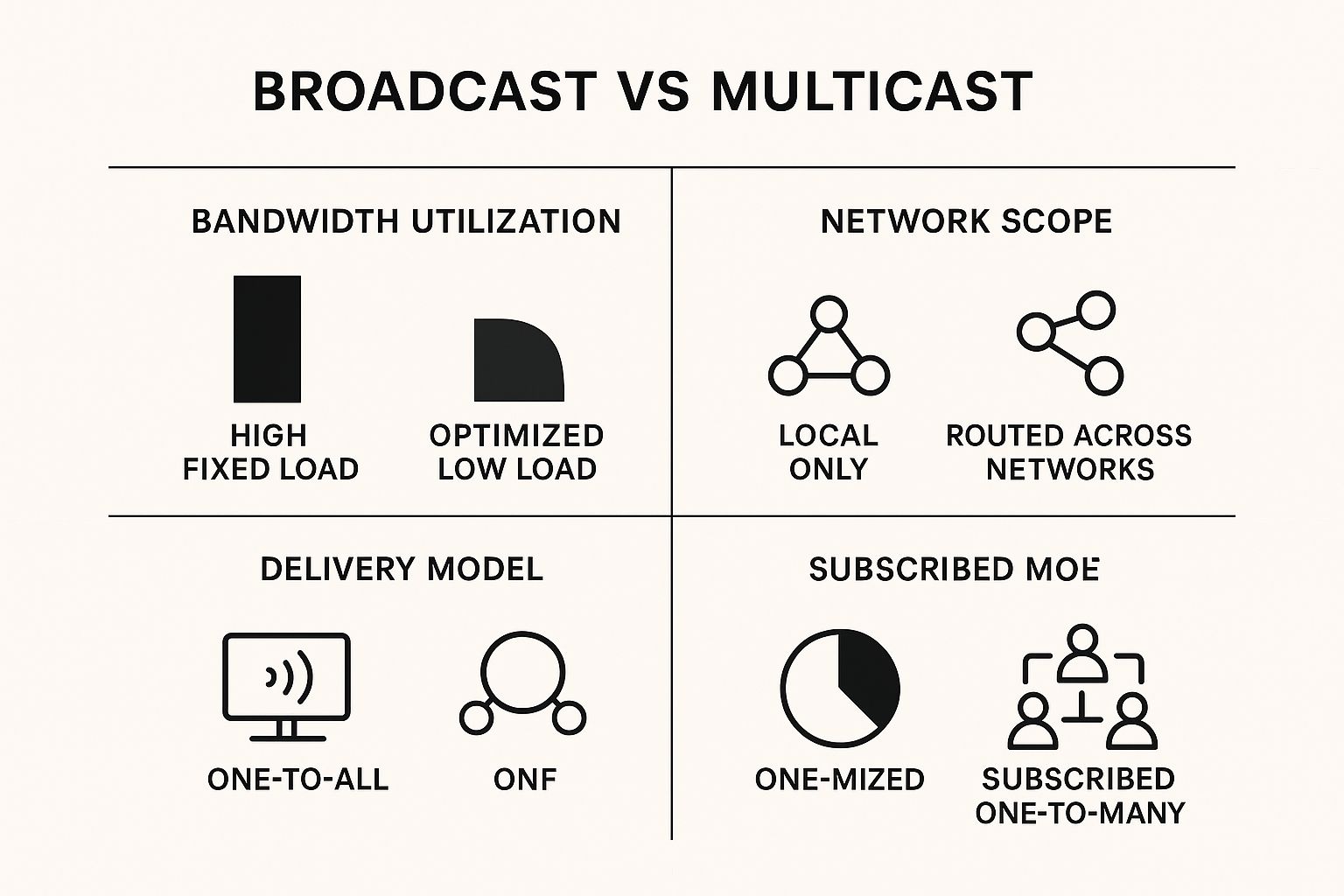
As you can see, broadcast puts a high, fixed strain on a local network. In contrast, multicast is much more strategic, optimizing bandwidth for targeted delivery that can span multiple networks.
The Bandwidth Dilemma
The most glaring difference between these two methods is bandwidth utilization. Broadcast is, by its very nature, a bandwidth hog. It sends a copy of every single packet to every device on the local network segment. This creates a high, fixed load whether one device or one hundred devices actually need the data.
Think about it this way: a 10 Mbps video stream on a network with 100 devices would consume 10 Mbps of bandwidth on every single port if sent via broadcast. It’s a brute-force approach that quickly saturates a local network and just doesn’t work for high-bitrate content like video.
Multicast, on the other hand, was built for efficiency. The source sends only one 10 Mbps stream into the network. From there, routers and switches do the smart work, replicating the stream only along paths leading to subscribed devices. If only 15 devices are watching, the network’s main arteries only have to carry that single 10 Mbps stream, which drastically cuts down on overall traffic.
How They Scale (or Don’t)
Scalability is where these protocols really show their true colors. Broadcast is fundamentally unscalable beyond a single local network. It operates at Layer 2 of the OSI model, which means its traffic is stuck inside a single broadcast domain—it can’t be routed across the internet.
This technical limitation makes it completely non-viable for reaching a geographically distributed audience.
The real game-changer is routing. Multicast operates at Layer 3, which allows its traffic to be intelligently routed across different networks and the internet. This is the architectural foundation that allows it to scale from a few local viewers to thousands around the globe.
This routing capability is what powers massive IPTV deployments and major live streaming events. Multicast can efficiently push a stream across a sprawling corporate WAN or even over specialized parts of the internet. That’s something broadcast is technically incapable of, making multicast the only real choice for any application that needs to go beyond a single physical location.
A Look at Latency and Processing Power
Finally, let’s talk about the load placed on your hardware. With broadcasting, every single device on the network has to receive and process every broadcast packet, even if it just throws it away immediately. This constant chatter chews up CPU cycles on every host, creating a pointless processing tax on the entire network.
Multicast sidesteps this problem entirely. Only devices that have explicitly subscribed to a multicast group receive the packets, leaving all other machines untouched. This targeted approach not only saves a ton of bandwidth but also protects the processing power of devices that aren’t part of the stream.
While multicast does depend on more intelligent network hardware (you’ll need multicast-aware routers and switches), the payoff is a significantly healthier and better-performing network, especially when it’s under the strain of a live video feed.
Technical Performance Breakdown Broadcast vs Multicast
To make the differences even clearer, let’s break down the technical performance metrics side-by-side. This table highlights the practical implications of choosing one protocol over the other.
| Feature | Broadcast | Multicast |
|---|---|---|
| Network Layer | Operates at Layer 2 (Data Link Layer) | Operates at Layer 3 (Network Layer) |
| Network Scope | Confined to a single local network segment (broadcast domain) | Routable across multiple networks and the internet |
| Bandwidth Usage | High and fixed; one copy sent to every device on the LAN | Efficient; one copy sent per link, replicated only where needed |
| Scalability | Very poor; does not scale beyond a local network | Highly scalable; supports thousands of recipients across a wide area network (WAN) |
| Hardware Requirement | Works with basic switches and hubs | Requires multicast-aware routers and switches (IGMP support) |
| Receiver Overhead | High; all devices must process packets, even if irrelevant | Low; only subscribed devices process packets |
| Delivery Model | One-to-all (within a local network) | One-to-many (to a specific group of subscribers) |
| Ideal Use Case | Service discovery on a small LAN (e.g., ARP requests) | Large-scale video streaming, IPTV, stock market data feeds |
As the table illustrates, the choice really comes down to scope and efficiency. For anything beyond a small, isolated network, multicast’s intelligent design provides a clear and necessary advantage for modern streaming applications.
Real-World Use Cases for Broadcast and Multicast
Knowing the technical specs is one thing, but the real test is seeing where these technologies actually get put to work. Broadcast and multicast aren’t just textbook terms; they’re the invisible engines driving a ton of services we rely on daily. Their distinct strengths and weaknesses make them a perfect fit for some jobs and a terrible choice for others.
Broadcast’s “one-to-all” model is like shouting into a crowded room. It’s not subtle, but it’s incredibly effective when you need to get a message to everyone nearby without knowing who they are. This simplicity is precisely what makes it perfect for core networking tasks.
Where Broadcast Is Essential
Broadcast truly shines when a device needs to discover something on the local network. It’s the go-to method for these foundational protocols.
- Getting an IP Address: When your laptop joins a Wi-Fi network, it sends out a DHCP broadcast message asking, “Can anyone give me an IP address?” The DHCP server hears this and responds.
- Finding a Physical Address: The Address Resolution Protocol (ARP) uses broadcasts to map a device’s IP address to its physical MAC address, a necessary step to deliver data packets locally.
In these cases, you need to reach every single device on the segment. The bandwidth inefficiency is a worthwhile trade-off for this essential discovery function, but it’s also the very reason it’s a non-starter for streaming content.
Dominant Applications for Multicast
When you need efficiency at scale, multicast is the answer. Its “one-to-many” delivery is the secret sauce behind modern, high-bandwidth streaming to specific groups of viewers.
A great modern example is the rollout of 5G. To handle the massive demand for high-quality video in crowded cities, telcos use multicast to deliver streams to thousands of mobile users at once without overwhelming the network. This is something broadcast could never dream of handling. As experts at Ericsson point out, it’s a key technology for making next-gen networks both scalable and reliable.
Multicast is the engine behind applications that need to deliver the same real-time data to a large but specific group of users simultaneously. Its efficiency makes experiences like live sports, financial data feeds, and online gaming possible at scale.
This efficiency is a game-changer across several industries:
- IPTV and Live Events: This is multicast’s classic use case. A provider can stream hundreds of live TV channels or a single high-profile sporting event to millions of subscribers using a single, efficient stream. If you’re curious about the mechanics, our guide on how to stream live video breaks down how these complex workflows are managed.
- Financial Data Distribution: On a trading floor, every millisecond counts. Investment firms use multicast to push real-time stock data to traders’ terminals, ensuring everyone gets the same critical information at the exact same time.
- Multiplayer Online Gaming: In a fast-paced game, multicast is used to send game state updates—like player positions and actions—to everyone in the match. This keeps the experience perfectly synchronized and responsive for all players.
How to Choose the Right Protocol for Your Needs
Deciding between broadcast and multicast isn’t about finding a single “best” protocol. The right choice hinges entirely on what you’re trying to achieve, what your network can handle, and who you’re trying to reach.
Think of it like this: a broadcast is a megaphone. It’s great for shouting an announcement across a small, defined space where everyone needs to hear it. A multicast, on the other hand, is more like a private conference line—it connects a specific group of people efficiently, no matter where they are, without disturbing anyone else.
Evaluating Your Core Requirements
To figure out which one fits your project, you need to ask a few honest questions. Your answers will point you in the right direction pretty quickly.
- Who is the audience? Are you trying to ping every single device on one local network segment, or are you delivering a stream to a specific group of subscribers who could be anywhere?
- What does your network look like? Is it a simple, isolated local network, or a complex corporate WAN that connects multiple buildings or even cities?
- How much does bandwidth matter? Is your network wide open with tons of capacity, or do you need to be careful to avoid slowing down other critical services?
- Do you need to scale up? Will your audience always be small and local, or do you anticipate it growing, possibly across different parts of the network?
The decision really boils down to a simple trade-off: Broadcast gives you universal reach on a local network, but it creates a ton of network noise. Multicast delivers scalable efficiency to a targeted audience. Getting this fundamental difference is the key to aligning your tech choice with your business goals.
Making the Final Call
Once you have the answers to those questions, the path forward should be much clearer. It’s all about matching the protocol’s strengths with your application’s real-world demands.
Choose broadcast communication when:
- You’re running a service discovery protocol (like ARP or DHCP) on a small, contained network.
- The application absolutely must reach every host inside a single broadcast domain.
- Bandwidth usage isn’t a major concern.
Choose multicast communication when:
- You’re streaming high-bandwidth content like live video or IPTV to many viewers.
- Your audience is a specific group of subscribers who have opted in.
- Conserving network bandwidth and reducing traffic congestion is a priority.
- The solution needs to scale effectively across a large corporate or campus network.
Don’t forget to look at your physical infrastructure, too. Multicast is designed to work well across different network layouts, including complex mesh and hybrid setups, which makes it very adaptable. Broadcasting, however, is typically stuck in simpler star or bus topologies, which really limits its usefulness in more sophisticated, modern networks. You can discover more insights about network topology on GeeksforGeeks.
And of course, for any serious video streaming project, you need to understand the other technologies at play. You can learn more about one of the most foundational technologies in our guide on the RTMP protocol.
For developers who want to build high-quality, scalable video streaming without getting bogged down in managing infrastructure, LiveAPI offers a powerful yet straightforward solution. Our APIs take care of the heavy lifting, from encoding to delivery, so your video application can launch fast and run perfectly. Get started with LiveAPI today and build your next great streaming experience.