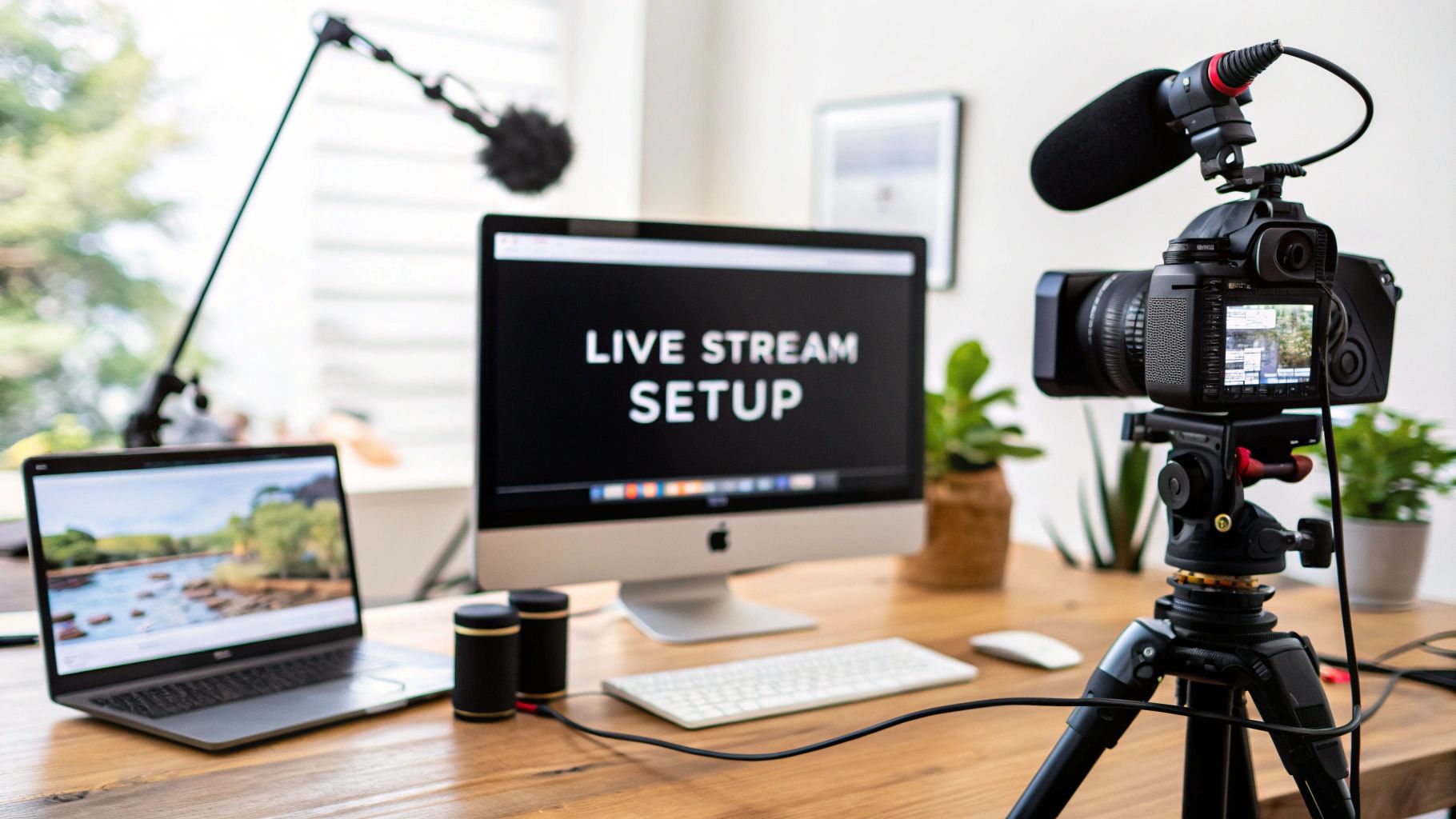
A live video streaming platform is essentially the complete toolkit for getting a live video from a camera to viewers anywhere in the world, instantly. Think of it as the engine that powers everything from a gamer’s live broadcast to a major news network’s breaking story, handling all the complicated technical stuff so creators can just focus on their content.
The Engine Behind Our Connected World
If you wanted to build a global television network from the ground up, you’d need a staggering amount of infrastructure: cameras, production studios, satellite trucks, and broadcast towers in every city. A modern live video streaming platform packs all of that into a single, cohesive service you can access from your computer.
The core problem these platforms solve is that delivering high-quality video in real-time is incredibly demanding. A platform takes your raw video feed and manages the entire journey—from processing it for delivery to making sure it plays perfectly on thousands of different devices, whether it’s a high-end TV or a smartphone on a shaky connection. It’s what makes live video feel so effortless for the viewer.
The Explosive Growth of Live Content
Live streaming has moved far beyond a niche hobby; it’s now a central part of how we interact online. We’re drawn to the immediacy and authenticity of live events, whether it’s watching a musician’s living room concert, attending a virtual company all-hands meeting, or getting updates on a story as it unfolds. The numbers tell the same story.
The global market for live video streaming hit roughly $100 billion in 2024, which is a four-fold jump in just five years. Experts predict that market will skyrocket to over $725.5 billion by 2034, cementing its place as a cornerstone of our digital economy. You can read more about the rapid expansion of the live streaming market and what’s driving this incredible growth.
This isn’t just a fleeting trend. It represents a fundamental shift in how people want to consume content. A few key things are pushing this forward:
- Accessibility: Anyone with a smartphone can go live to the world. The old barriers to broadcasting have completely disappeared.
- Engagement: Live video is interactive. Viewers can chat and react in real-time, creating a shared experience that recorded video just can’t replicate.
- Monetization: For businesses and creators, live streaming opens up new ways to earn revenue directly from their audience through ads, subscriptions, and tips.
At its heart, a live video streaming platform is a great equalizer. It gives everyone access to the powerful, scalable technology needed to turn any camera into a global broadcast channel, making reliable video delivery something anyone can achieve. In this guide, we’ll pull back the curtain and look at how it all works.
How Live Streaming Technology Actually Works
To really get a feel for what a live video streaming platform does, it helps to look under the hood. The journey a video takes from a camera to millions of screens worldwide is a technical marvel—a high-speed relay race that happens in milliseconds. It’s a complex process that a good platform makes seem simple, ensuring every viewer gets a smooth, high-quality picture.
Let’s break down this journey into its core parts. Understanding these steps shows just how much work goes on behind the scenes to make live video feel so effortless.
The First Step: Encoding and Transcoding
Raw video footage is huge. It’s far too big to send over a normal internet connection without frustrating delays. The first hurdle is to shrink it down, and that’s where encoding comes in.
Think of encoding like vacuum-sealing your clothes for a suitcase. It uses special algorithms, called codecs, to compress the video into a much smaller, web-friendly size. This can make the file up to 55% smaller without any obvious loss in quality.
But what about the viewers? Not everyone has the same internet speed or device. Someone watching on a 4K TV with a fiber connection has different needs than someone on a smartphone with a shaky 4G signal. This is precisely why transcoding is so critical.
Transcoding is the process of creating multiple copies of the original stream at different quality levels, or bitrates. It’s like a restaurant preparing a dish in full-size, half-size, and appetizer-size portions to suit every appetite.
These different versions are the key to the next step, which is arguably the most important for a buffer-free experience.
Delivering a Smooth Experience with Adaptive Bitrate Streaming
Now that we have multiple quality versions of the stream ready to go, the video player on a viewer’s device needs to intelligently pick the right one. This is handled by a technology called Adaptive Bitrate Streaming (ABR).
ABR acts like a smart GPS for your video stream. It constantly checks the viewer’s network conditions, like internet speed and CPU load. If the connection is strong, it pulls down the crisp 1080p or 4K version. If the network suddenly slows down, it seamlessly switches to a lower-quality version to prevent that dreaded buffering wheel.
This dynamic switch happens silently in the background, ensuring the video keeps playing without interruption. It’s the secret sauce for delivering a consistent experience to a wide audience. Protocols like HLS are fundamental to this, and you can learn more in our deep dive into what HTTP Live Streaming is.
The Final Mile: Getting Content to Viewers with a CDN
Once the video is encoded and prepped for ABR, it has to get to potentially millions of viewers around the globe. Sending it from a single server would create a massive bottleneck and a ton of lag. This is where a Content Delivery Network (CDN) saves the day.
A CDN is a global network of servers, often called Points of Presence (PoPs), strategically placed in different geographic locations. The live video stream is essentially copied and stored on these servers all over the world.
When a viewer in London clicks play, the stream comes from a nearby server in London, not from the original source in Los Angeles. This dramatically cuts down the physical distance the data has to travel, which is the main culprit behind latency.
The technologies that make this global delivery possible are what fuel the incredible growth we’re seeing in the live streaming market.
This kind of market expansion is only possible because the underlying infrastructure can scale to meet the demand.
To make these concepts even clearer, here’s a quick breakdown of how each piece of the puzzle contributes to the final product you see on your screen.
Core Streaming Technologies Explained
| Technology | Primary Function | Benefit for the Viewer |
|---|---|---|
| Encoding/Transcoding | Compresses video and creates multiple quality versions | Makes streaming possible on standard internet connections. |
| Adaptive Bitrate (ABR) | Intelligently selects the best quality stream for a device | Prevents buffering by adapting to changing network conditions. |
| Content Delivery (CDN) | Distributes the stream across a global network of servers | Delivers video quickly with low latency, no matter where you are. |
Together, these technologies form the backbone of any reliable live video streaming platform. They work in perfect harmony to solve the fundamental challenges of delivering high-quality, real-time video to anyone, anywhere.
Building Custom Solutions with Developer Tools
While a slick dashboard is great for managing a few streams, the real magic of a modern live video streaming platform is unlocked through its developer tools. This is where a simple service becomes a powerful foundation, giving you the freedom to build completely custom video experiences and automate even the most complex workflows.
Think of it like getting a box of high-tech LEGOs. The platform provides the specialized bricks—the core streaming infrastructure—and you get to assemble them in any way you can imagine. For developers and businesses, this means you’re no longer stuck inside a graphical interface. You can weave live video directly into your applications, websites, and backend systems.
The three key tools that make this happen are APIs, SDKs, and Webhooks. Each one plays a unique but complementary role in creating a seamless, automated streaming environment.
Using APIs to Programmatically Control Streams
The Application Programming Interface (API) is the nerve center of developer integration. It’s essentially a set of rules that lets your software talk directly to the streaming platform’s software. So, instead of a human clicking buttons to start or stop a stream, your own code can make it happen automatically.
For example, a solid REST API lets you programmatically:
- Create and manage live streams without ever logging into a dashboard.
- Start, stop, and check stream status based on triggers from your own application.
- Pull analytics data to build custom reporting dashboards for your users or internal teams.
- Tweak stream settings like recording or multistreaming on the fly.
This kind of control is a game-changer for building scalable products. Imagine an online course platform that automatically spins up a unique live stream for every new class a teacher schedules. That’s the power of API-driven automation—it turns repetitive manual tasks into efficient, hands-off operations.
Simplifying Development with SDKs
If APIs provide the raw power, Software Development Kits (SDKs) make that power much easier to handle. An SDK is a neat package of pre-written code, libraries, and tools tailored for a specific programming language or platform, like iOS, Android, or JavaScript.
Rather than building raw API calls from scratch (which can get complicated), a developer can use an SDK to get common jobs done with just a few lines of code. For instance, dropping a live video player into a mobile app could be as simple as importing the SDK and using a pre-built component.
SDKs dramatically shorten development cycles. They handle the boilerplate code for tasks like authentication, data formatting, and error handling, allowing developers to focus on building the core features of their application rather than the underlying streaming mechanics.
This simplification is crucial for getting products out the door faster. Teams can integrate high-quality live video into their apps in a matter of days instead of months, giving them a huge competitive edge. Many platforms, including LiveAPI, offer SDKs to help you quickly add features. For a deeper dive into the tech that powers this, you can explore guides on foundational protocols, like our article explaining what the RTMP protocol is and how it works.
Staying Informed with Webhooks
The final piece of this developer puzzle is the Webhook. Think of it this way: if an API is for telling the platform what to do, a webhook is for the platform to tell you when something important happens. It’s a real-time notification system built for your application.
Here’s the rundown: you give the streaming platform a URL and tell it which events you care about. When one of those events happens, the platform instantly sends a message to your URL with all the details.
Common webhook events include:
- Stream Started: Trigger a “Go Live” notification to all your app users.
- Stream Ended: Kick off an automated process to transcribe the recorded video.
- New Recording Ready: Automatically move the finished recording to your VOD library.
- Stream Error: Instantly alert your support team that a broadcast is having issues.
Webhooks are the connective tissue for creating reactive, event-driven systems. They allow your different services to respond immediately to what’s happening in the stream, creating a fully automated and intelligent video ecosystem. When used together, APIs, SDKs, and webhooks empower you to build truly one-of-a-kind solutions on top of a powerful live streaming platform.
A Look Under the Hood: Live Streaming Architecture
To really get what a live video streaming platform does, you have to peek behind the curtain at its architecture. Think of this as the end-to-end blueprint that gets your video from a single camera into the hands of potentially millions of viewers, all in the blink of an eye. It’s a surprisingly complex workflow that platforms like LiveAPI are built to handle for you.
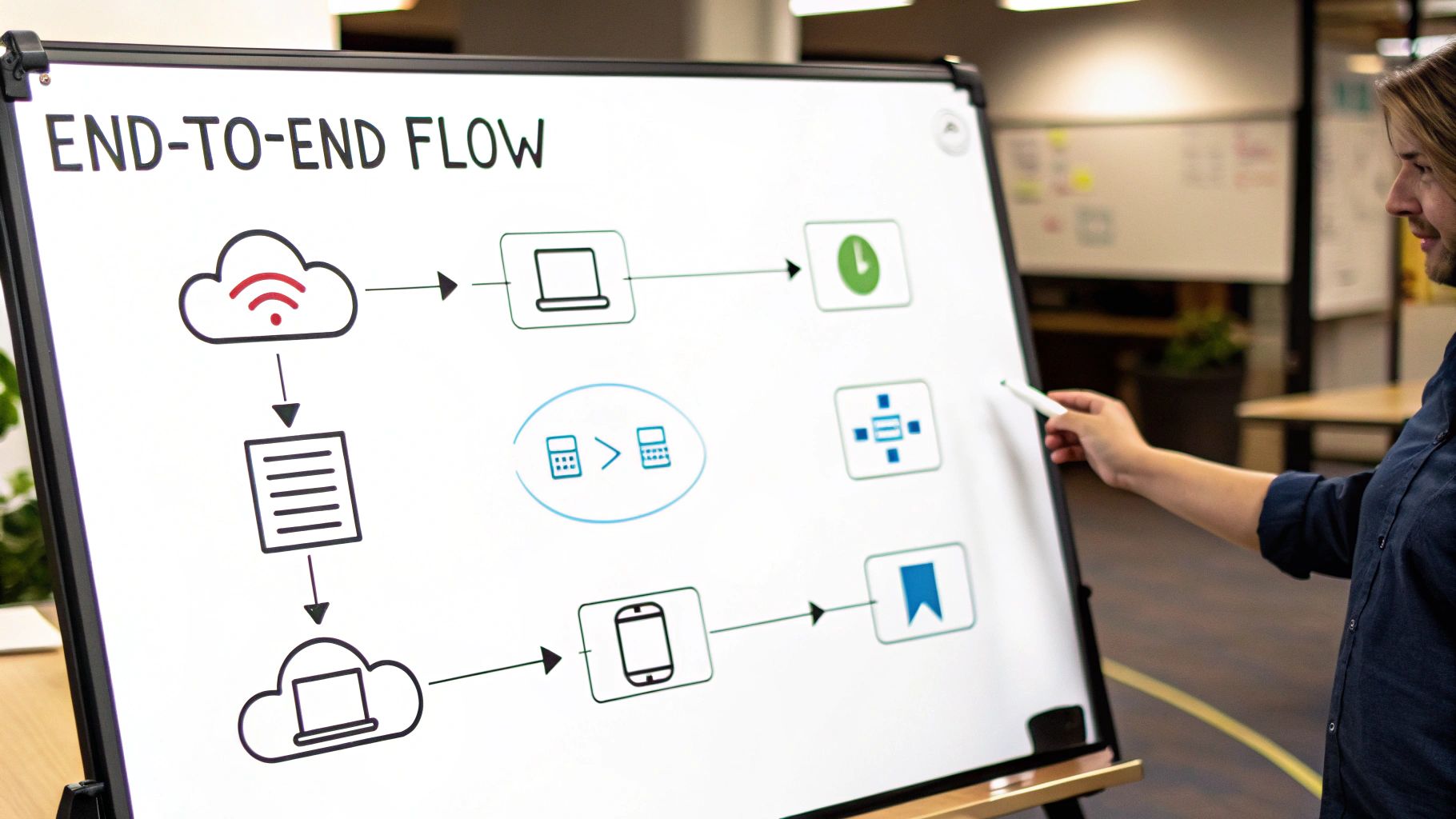
The entire journey of a live video really boils down to four key stages. Each step in the chain has a specific job to do, all working together to make sure the final stream is stable, looks great, and arrives with as little delay as possible.
The Four Stages of a Live Stream
- Ingest: This is where it all begins. The ingest stage is simply the platform receiving your raw video feed. It doesn’t matter if it’s coming from a high-end studio camera, a smartphone, or broadcasting software—this initial handoff has to be rock-solid.
- Processing: Once the platform has the raw video, it gets to work. The video is transcoded into different quality levels to enable smooth adaptive playback, security measures like Digital Rights Management (DRM) are applied, and it’s packaged up for its journey across the internet.
- Distribution: Now that the video is prepped and ready, it’s time to send it out to your audience. This is where a Content Delivery Network (CDN) steps in. The CDN copies and stores the video on servers all over the world, so when a viewer hits play, the stream comes from a server nearby, ensuring a fast and smooth experience.
- Playback: The final stop is your viewer’s screen. The video player on their device talks to the CDN, intelligently picks the best quality stream for their current internet connection, and delivers a seamless, buffer-free show.
This four-stage process is the fundamental backbone of pretty much every professional live stream you’ve ever watched.
One-To-Many vs. Interactive Architectures
Not all live streams have the same goal, and their architecture reflects that. The two most common models are the massive one-to-many broadcast and the nimble, interactive stream. Each one is built with a different priority in mind.
A one-to-many broadcast—think of a huge sporting event or a major concert—is all about scalability and reliability. The main goal is to deliver a perfect, high-quality stream to a massive, mostly passive audience. Latency might be a few seconds higher, but that’s a trade-off to guarantee the system can handle millions of viewers at once without a hiccup.
On the other hand, an interactive, ultra-low latency stream for something like a live auction or a group video call is obsessed with speed. Here, the delay between what you do and what your viewers see has to be less than a second to make real-time conversation possible. This demands specialized protocols and a completely different architectural approach that puts speed above all else.
Building either of these architectures from the ground up is a massive undertaking. You’d have to piece together complex components, manage a global network of servers, and make sure every part talks to the others flawlessly. This is the real value a dedicated live streaming platform brings—it offers this entire intricate setup as a managed service.
Why The CDN is a Game-Changer
In this whole setup, the distribution stage is often the trickiest and most expensive part to get right. This is why the CDN’s role is so incredibly important for delivering a professional experience to a global audience. A well-oiled CDN slashes buffering by making sure the video data travels the shortest distance from the server to the viewer.
Picking the right network can make or break your stream’s performance. You can dive deeper into this topic in our guide on choosing the best CDN for video streaming. Ultimately, this global network is what separates a small, local stream from a professional, worldwide broadcast. Without it, viewers far away would suffer from painful lag and probably just click away. A powerful CDN is the key to achieving both speed and scale.
How Top Industries Use Live Streaming
The real magic of a live video streaming platform is its sheer flexibility. The same core tech that beams a global soccer match to millions of screens can just as easily power an internal company all-hands or a creator’s live shopping event. When we look at how different industries are actually using this technology, we start to see its versatility and can even spot new opportunities for our own projects.
From media giants to solo entrepreneurs, live video is now a non-negotiable tool for connecting with people. But each of these groups needs something very different from the platform that powers their stream.
Media and Entertainment Broadcasting at Scale
For media companies, live streaming is the new broadcast television. We’re talking about massive events like the Super Bowl, live concerts from sold-out arenas, and breaking news as it happens. For them, the mission is crystal clear: deliver a perfect, high-quality stream to a huge, spread-out audience without a single glitch.
The technical demands here are enormous. These organizations are looking for a platform with:
- Rock-solid reliability that can handle millions of people watching at the same time without buckling.
- Robust security features, like digital rights management (DRM), to stop premium content from being pirated.
- Low-latency delivery so viewers at home feel like they’re right there in the action—something absolutely critical for sports.
- Advanced monetization tools to stitch in broadcast-quality ads that look just like they do on TV.
For a media company, a streaming platform isn’t just a piece of software. It’s the foundational infrastructure that has to perform flawlessly when the world is watching.
The Creator Economy and Interactive Content
Live streaming has completely reshaped the creator economy. It’s given rise to a whole new wave of entrepreneurs who have built entire communities—and businesses—around their passions, whether that’s gaming, cooking, or selling products live.
Unlike big media, a creator’s main goal is direct, personal interaction with their audience. So, their platform needs are all about building and nurturing that connection.
For a creator, the stream is a two-way conversation. Features that enable real-time chat, viewer polls, and direct monetization through tips or subscriptions are not just nice-to-haves—they are the very foundation of the business model.
This is exactly where platforms like YouTube Live, Twitch, and TikTok Live have hit a home run. As of early 2025, YouTube Live is the most popular platform, with 52% of viewers tuning in regularly. Twitch still reigns supreme in the gaming world, where fans watched over 71 million hours daily in 2024. Meanwhile, TikTok Live’s growth, particularly in Asia, has been off the charts, even starting to rival Twitch in total hours watched. You can find more details about these live streaming trends and see how the market is shifting.
Enterprise Communication and Virtual Events
In the business world, live streaming platforms have become essential for talking to people both inside and outside the company. Businesses now use them for everything from all-hands meetings and employee training sessions to massive virtual conferences and new product launches.
Here, the priorities pivot once more. Security and control are everything. An enterprise needs a platform that can:
- Ensure secure access with tools like password protection or SSO integration to keep sensitive internal meetings private.
- Provide detailed analytics to see how many employees tuned in and measure the event’s overall impact.
- Offer seamless integration with the company’s existing software, like calendars and marketing tools.
- Guarantee a high-quality stream for every employee, whether they’re in the main office or working from home on the other side of the planet.
Looking at these very different use cases makes one thing obvious: there’s no “one-size-fits-all” live video streaming platform. The right choice always comes down to what you’re trying to achieve with your broadcast and who you’re trying to reach.
Choosing the Right Live Streaming Platform
 Picking the right live video streaming platform can feel overwhelming. With so many options, it’s easy to get bogged down in endless feature lists. The key is to step back and focus on what truly matters for your specific project.
The best platform for you will be a perfect match for your audience, your technical setup, and your ultimate goals. It’s less about finding a service that can do everything and more about finding the one that does exactly what you need it to do, and does it well. The first step is to ask the right questions and build your own scorecard to measure each potential partner against.
Evaluating Key Platform Capabilities
To cut through the noise, anchor your evaluation around five critical areas. Each of these pillars represents a core part of delivering a professional and reliable live stream.
- Scalability and Reliability: Can the platform grow with you? You need a service that can handle ten viewers just as smoothly as it handles ten thousand. Don’t be shy about asking potential vendors about their infrastructure and CDN partners. You need confidence that your stream won’t buckle under pressure when you have a surge in traffic.
- Latency Requirements: How “live” does your live stream need to be? For a simple broadcast, a delay of a few seconds is perfectly acceptable. But if you’re building a live auction, a sports betting app, or a highly interactive webinar, you’ll need ultra-low latency. Be crystal clear on this point, as it’s one of the biggest factors influencing the underlying technology and cost.
- Pricing and Total Cost: Does the pricing model make sense for your business? Pay-as-you-go plans are fantastic for unpredictable traffic, while monthly subscriptions can offer more predictable costs. Make sure you look beyond the advertised price—ask about charges for bandwidth, storage, and transcoding to get a true picture of the total cost of ownership.
The best live video streaming platform isn’t just a tool; it’s a strategic partner. Your choice should empower you to build the exact video experience you envision, with the flexibility to grow and adapt as your needs change.
Developer Tools and Security
For anyone building a custom application, the quality of the stream is only half the battle. The ability to integrate and customize the platform is what separates a basic service from a true foundation for innovation.
And, of course, you can’t afford to overlook security. Your content and your audience’s data are valuable assets that need protection.
Here’s what to dig into:
- Developer Experience: How robust are the APIs and SDKs? A platform with clear, comprehensive documentation and helpful code examples, like what you’ll find with LiveAPI, can save your team countless hours of development time. It’s the difference between a smooth integration and a frustrating one.
- Security Measures: What tools are available to control who can view your stream? Look for features like password protection, geo-blocking, or token-based authentication. If you’re streaming premium content, Digital Rights Management (DRM) is non-negotiable to prevent piracy.
By methodically working through each of these areas, you can see past the marketing hype. You’ll be able to choose a live video streaming platform that genuinely aligns with your technical needs and business goals, setting you up for success from day one.
Frequently Asked Questions
Even after you get your head around the tech, a few questions always seem to come up when you’re digging into live video streaming platforms. Let’s clear up those lingering details with some straight-to-the-point answers.
Live Streaming Vs Video On Demand
So, what’s the real difference between a live streaming platform and a VOD platform? The easiest way to think about it is like watching a football game live versus catching the highlights later. A live streaming platform is engineered for real-time delivery; its whole job is to get an event from the source to a viewer’s screen as it happens.
A Video On-Demand (VOD) platform, however, is all about storing and delivering videos that have already been recorded. While a lot of modern platforms can do both, the technology under the hood is tuned for completely different jobs.
The core distinction is timing. Live streaming is all about immediacy and what’s happening this very second. VOD is about building a library of content that people can browse and watch whenever they want.
Understanding Latency In Live Streams
Why isn’t a “live” stream truly instant? That slight delay between something happening in real life and you seeing it on your screen is called latency. It’s just a natural part of the journey your video takes—from being captured, encoded, processed, and then sent across the internet to viewers around the world.
For a typical broadcast, a delay of 15–30 seconds is completely normal and doesn’t affect the experience. But if you’re running something interactive, like a live auction or a real-time Q&A session, you need that delay to be as short as possible. That’s where ultra-low latency solutions come in, capable of cutting the lag down to under a second. The right choice really just depends on how much you need your audience to interact in the moment.
Ready to build your own custom video experience? LiveAPI provides the powerful APIs and robust infrastructure you need to integrate high-quality, scalable live video into any application. Start building with LiveAPI today.