A live stream CDN is a purpose-built global network of servers, all working together to deliver live video content to viewers anywhere in the world, fast. Think of it as the crucial link between where you’re broadcasting from and your audience. It’s the secret sauce that tackles the biggest live streaming headaches: latency, buffering, and scaling to a large audience.
Why a CDN Is the Backbone of Modern Broadcasting
Imagine you’re running a food truck, and suddenly, a massive crowd shows up for lunch. You’d get overwhelmed fast, right? Orders would pile up, people would wait forever, and nobody would have a good experience. That’s pretty much what happens when you try to live stream to a big audience from a single server—it just can’t keep up. The result? That dreaded buffering wheel and frustrated viewers.
A live stream CDN is like having a whole fleet of identical food trucks stationed all over the city. These are called Points of Presence (PoPs), or edge servers. When you start your stream, it’s not just going to one place; it’s sent to the nearest PoP and then instantly distributed across the entire network.
From One Server to a Global Network
So, when a viewer in London hits ‘play’ on your stream originating from Los Angeles, they aren’t pulling the video from thousands of miles away. Instead, they’re connecting to a CDN server right there in London. This slashes the distance the data needs to travel, which is the key to cutting down latency and keeping the stream smooth.
This distributed setup is what allows broadcasters to deliver high-quality streams to millions of people at the same time. A single server might struggle with a few hundred viewers, but a CDN can handle massive audiences without breaking a sweat. It’s the invisible technology powering huge events like the Super Bowl, global product launches, and your favorite creators on Twitch and YouTube.
A live stream CDN doesn’t just pass your video along. It intelligently routes, copies, and optimizes it in real-time, making sure every single viewer gets the best possible quality for their connection.
This technology isn’t just important; it’s a massive, growing industry. The overall content delivery network (CDN) market was valued somewhere between $14 to $15 billion in 2025. Projections show it could explode to anywhere from $60 billion to $144.9 billion by the mid to late 2030s, all thanks to our insatiable appetite for high-quality video. You can dive deeper into the growth drivers of the CDN market on futuremarketinsights.com.
Before a CDN, broadcasters faced a constant battle with technical limitations. Now, these networks solve some of the most persistent problems in live streaming.
Streaming Problems Solved by a Live Stream CDN
| Streaming Problem | How a Live Stream CDN Solves It |
|---|---|
| Buffering and Lag | By caching content on servers closer to the viewer, the CDN drastically reduces the physical distance data travels, minimizing latency and buffering. |
| Server Overload/Crashes | It distributes traffic across a vast network of servers. If one server goes down or gets too busy, traffic is automatically rerouted to the next nearest one. |
| Poor Global Performance | Viewers in different countries connect to local PoPs, ensuring a fast and reliable experience for everyone, no matter where they are. |
| Inability to Scale | CDNs are built to handle huge, sudden spikes in viewership, allowing streams to scale from a handful of viewers to millions without a drop in quality. |
| High Bandwidth Costs | By offloading traffic from the origin server, CDNs significantly reduce the bandwidth costs you’d otherwise have to pay for. |
In short, a CDN takes the heavy lifting of delivery off your plate.
By handing off this critical job, a CDN guarantees your broadcast is:
- Scalable: Go from ten viewers to ten million without having to worry about your server’s capacity.
- Reliable: If one server in the network has a problem, your stream doesn’t die. Traffic is seamlessly rerouted to a healthy server, keeping your broadcast online.
- Fast: Closing the distance between your content and your audience means a snappier, near-real-time experience with minimal delay.
How Your Stream Travels Through a CDN
So, how does a live stream CDN actually work its magic to deliver a smooth experience? Let’s trace a single frame of your video as it zips from your camera to a viewer’s screen on the other side of the world. Think of it as a high-tech global relay race, where your video is the baton.
This entire journey is a rapid, four-step process that happens in the blink of an eye. It’s what turns your raw camera feed into a stable, high-quality stream that anyone, anywhere, can watch.
Step 1: Ingest
It all starts with ingest. This is the moment your stream officially enters the CDN. Your broadcasting software sends your video feed to the nearest CDN entry point, called an ingest server. For this first leg of the race, protocols like RTMP are often used to ensure a stable and fast handoff. If you want to dive deeper into that initial connection, we have a great guide explaining what the RTMP protocol is and why it’s so important.
Getting this first step right is critical. By connecting to the closest server, the video’s initial trip over the public internet is as short as possible, which immediately cuts down the risk of lag or dropped frames.
Step 2: Processing
Once your stream is safely inside the CDN’s network, it hits the processing stage. Here, the CDN works like a universal translator for video. Your single, high-quality stream goes in, and multiple different versions come out. This is a process known as transcoding.
The CDN essentially creates several copies of your stream at various quality levels—think 1080p, 720p, 480p, and so on. This is the secret sauce behind Adaptive Bitrate Streaming (ABS). It means a viewer with a fast Wi-Fi connection gets a perfect HD picture, while someone on a spotty mobile network gets a slightly lower-quality version that plays without buffering. It’s all about tailoring the stream to fit each viewer’s unique situation.
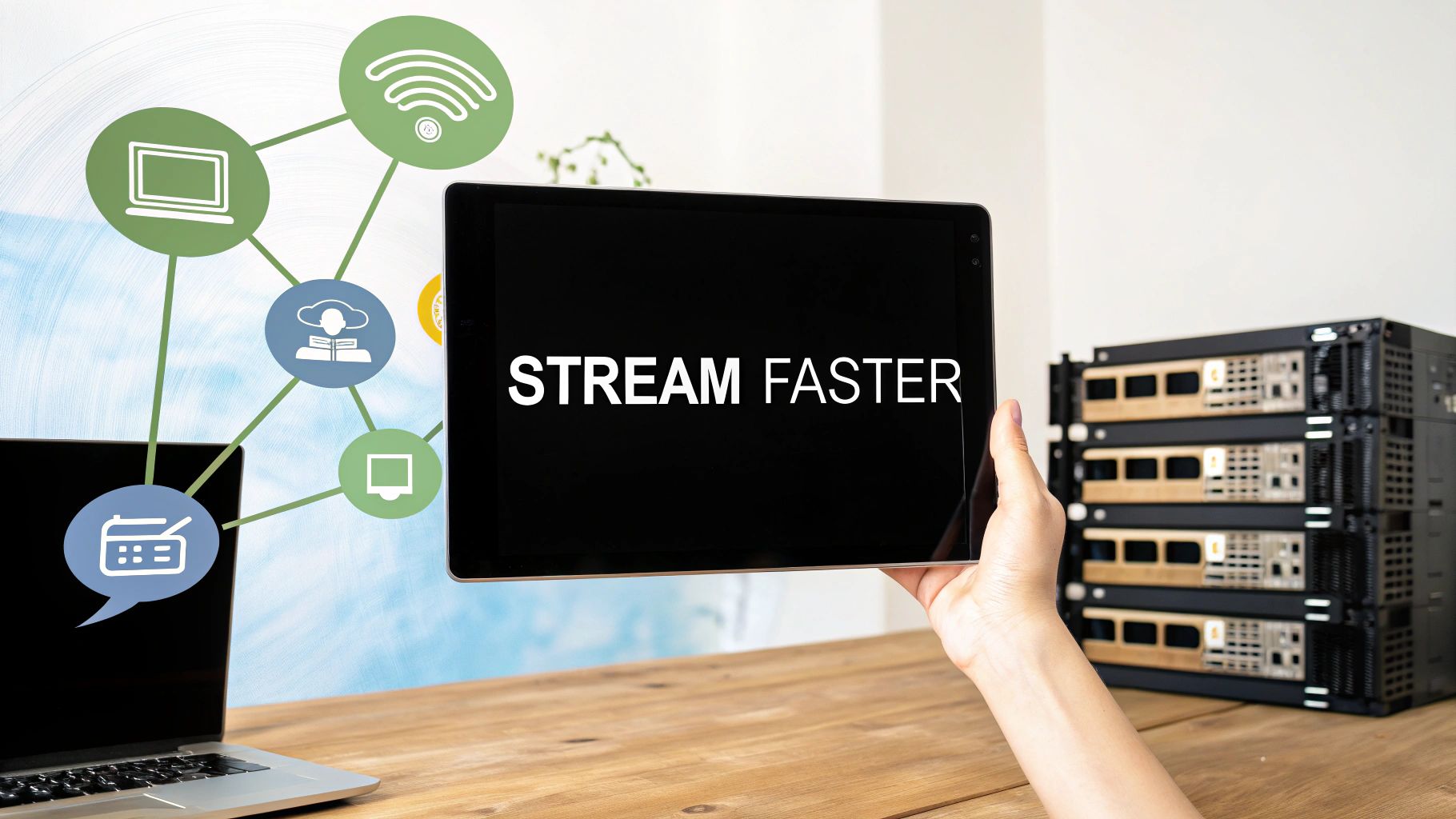
This visual breaks down how a CDN takes common streaming problems and turns them into a reliable, smooth experience.
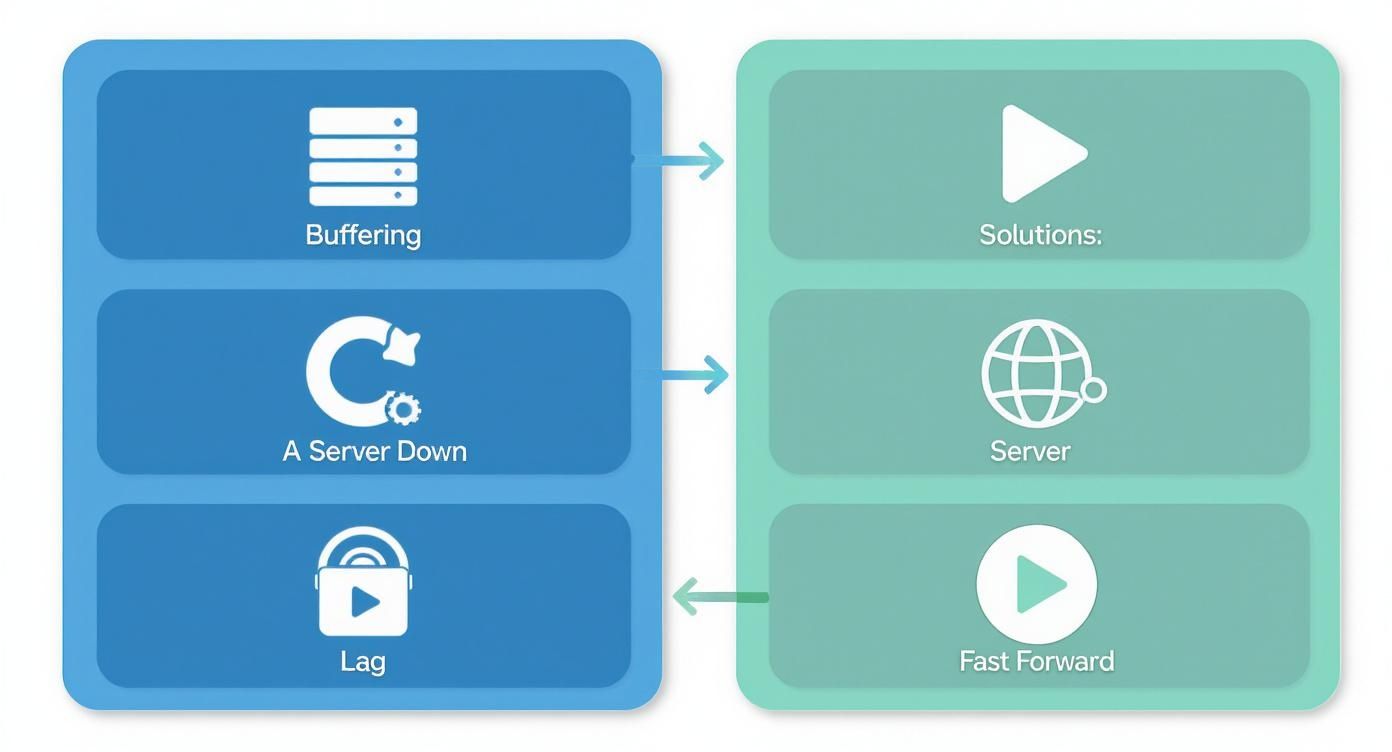
By swapping out long, direct connections for this smart, distributed network, the CDN solves the biggest headaches in streaming: buffering, server overload, and global lag.
Step 3: Distribution
With the stream now available in multiple flavors, the distribution phase begins. This is where the “network” in Content Delivery Network really shows its power. The transcoded video segments are instantly copied and pushed out to the CDN’s entire global web of edge servers, also known as Points of Presence (PoPs).
Instead of waiting for a viewer in Tokyo to pull the video all the way from a server in New York, the CDN has already placed a copy on an edge server right there in Tokyo. This massive, parallel copy-and-paste job happens in seconds, getting the whole network ready to handle viewers from every corner of the globe at the same time.
Step 4: Playback
The final leg of the journey is playback—the moment of truth for the viewer. When someone hits the play button, their device doesn’t request the stream from your original server. Instead, it talks to the CDN edge server that’s geographically closest to them.
That local server immediately starts sending the video. The viewer’s video player is smart, too. It constantly checks the internet connection and asks for the best possible quality it can handle without stuttering. If the Wi-Fi signal weakens, the player simply asks the CDN for a lower-quality stream, and the switch happens seamlessly. This constant, automatic adjustment is what creates that professional, buffer-free experience we all expect.
Key Benefits of Using a Live Stream CDN

Knowing the “how” of a live stream CDN is great, but the real magic is in the “why.” What tangible results does it actually deliver? Let’s move past the technical journey of a video packet and get straight to the powerful advantages a distributed network brings to your broadcast. These aren’t just small tweaks; they’re the pillars that make high-quality, global streaming possible.
The demand for this kind of infrastructure is exploding. The market for live video CDNs was valued at roughly $15 billion in 2025 and is expected to climb by a staggering 18% each year through 2033. This isn’t just hype; it’s a direct response to audiences demanding a flawless streaming experience.
Reach a Global Audience Instantly
The most obvious and powerful benefit is global scalability. Without a CDN, your stream is tethered to a single origin server. Imagine trying to broadcast a major product launch to a worldwide audience from that one server. It’s a recipe for disaster. The server would get overwhelmed almost instantly, leading to crashes and a terrible experience for everyone tuning in.
A live stream CDN shatters that bottleneck. By spreading your stream across a massive network of servers, it can handle huge, sudden spikes in viewership without breaking a sweat. It doesn’t matter if you have a thousand viewers or a million—the network simply absorbs the load, giving every single person a stable connection.
- Real-World Example: Think about a record-breaking boxing match. A CDN is what allows millions of pay-per-view buyers on different continents to watch simultaneously without a single server becoming a point of failure.
Drastically Reduce Latency
Latency—that annoying delay between when something happens in real life and when it appears on screen—is the enemy of live streaming. High latency can kill any interactive element, from live Q&A sessions to in-game sports betting. A CDN attacks this problem by dramatically shortening the physical distance your video data has to travel.
Instead of a viewer in Tokyo pulling your stream from a server in New York, they connect to a local server (a Point of Presence, or PoP) just a few miles away. This simple change cuts down the data’s round-trip time, which can slash the “glass-to-glass” delay from over 30 seconds down to just a few.
By closing the physical gap between your content and your audience, a CDN makes your stream feel immediate and responsive. That’s absolutely essential for keeping viewers engaged in real-time.
Ensure Unshakeable Reliability
Here’s a scary thought: what happens if your main server dies mid-broadcast? Without a CDN, your stream is toast. With a CDN, it’s a complete non-issue. The distributed nature of the network gives it built-in redundancy and reliability.
If one server or even an entire data center goes down, the CDN’s traffic management system automatically and instantly reroutes viewers to the next-best server. This failover is totally seamless and invisible to your audience. Your stream stays online, period. This is precisely why professional broadcasters consider a CDN non-negotiable.
Deliver a Superior Viewer Experience
At the end of the day, all these technical perks add up to one thing: a fantastic viewer experience. Less buffering, faster startup times, and consistently higher video quality all work together to keep your audience hooked. Viewers today have zero patience for choppy streams—even a few seconds of buffering can make them click away for good.
A CDN directly improves this by enabling technologies like Adaptive Bitrate Streaming. It intelligently delivers multiple quality versions of your stream, letting each viewer’s player automatically pick the best one their internet connection can handle. To get a better sense of how this works, see our deep dive on how adaptive bitrate streaming works. The result is longer watch times, happier viewers, and a much more professional look for your brand.
Choosing the Right Live Stream CDN Features
Picking a live stream CDN isn’t a simple, one-size-fits-all task. The right partner offers a toolkit of features that directly solve your broadcasting needs, whether you’re hosting a massive esports tournament or an internal company town hall. If you get this wrong, you’re looking at laggy streams, frustrated viewers, and wasted money.
To get it right, you need to understand the core features that make or break a live stream. It’s less about the price tag and more about the technical muscle that will ensure your stream is a success.
This decision is more critical than ever. The global live streaming market, valued at around $106.5 billion in 2025, is on a massive growth trajectory, projected to hit an incredible $725.5 billion by 2034. That growth is fueled by viewers who expect a flawless, low-latency experience, and your CDN is the key to delivering it. You can dig into the rapid expansion of the live streaming market on custommarketinsights.com.
Foundational Protocol Support
At the very heart of a CDN is its ability to “speak” the right video languages, or protocols. Think of these as the rules for how video travels online. A good CDN needs to be fluent in the right ones for both receiving your stream (ingest) and sending it out to your viewers (delivery).
- For Ingest: Standard protocols like RTMP (Real-Time Messaging Protocol) and SRT (Secure Reliable Transport) are used to send your stream to the CDN. RTMP is the old reliable, supported by nearly all broadcasting software. SRT is the modern alternative, offering better performance and security, especially over shaky internet connections.
- For Delivery: When it comes to reaching your audience, HLS (HTTP Live Streaming) and MPEG-DASH are the go-to protocols. They work by chopping the video into tiny pieces, which allows for adaptive bitrate streaming and ensures a smooth show for everyone, no matter their device or connection speed.
Cloud Transcoding and ABR
Here’s a feature you absolutely can’t skip: cloud transcoding. This is the magic that happens on the CDN’s servers where your single, high-quality stream is converted into multiple different versions, each with a different resolution and bitrate.
This process is what enables Adaptive Bitrate Streaming (ABR). ABR is the smart technology that lets each viewer’s video player automatically pick the best stream quality their internet can handle at that very moment.
Without ABR, someone on a slow connection would get stuck in a buffering nightmare trying to load a 4K stream. With it, their player just grabs a lower-quality version and keeps the video playing without interruption. It’s the secret sauce behind a professional, buffer-free viewing experience.
A Robust Global PoP Network
The physical size and spread of a CDN matter—a lot. A Global Point of Presence (PoP) Network is just a fancy term for the worldwide collection of servers a CDN operates. The more PoPs a CDN has, and the smarter their placement, the faster your stream will be.
When a CDN has servers physically close to your viewers, the video data doesn’t have to travel as far. This simple fact dramatically cuts down latency, giving you faster load times and a much snappier, more responsive stream. For live, interactive events, this is a game-changer.
Security and Content Protection
If your stream is valuable, people will try to steal it. Protecting your content from piracy and unauthorized access is crucial, especially if you’re charging for it. A solid live stream CDN should come with powerful security features built-in.
Key security tools include token authentication, which acts like a digital ticket to ensure only paying or authorized viewers can get in, and DRM (Digital Rights Management), which encrypts your video to stop people from illegally copying or sharing it.
Actionable Analytics and Reporting
You can’t fix problems you don’t know exist. That’s why deep analytics and reporting tools are essential. They give you a real-time window into how your stream is performing and how your audience is behaving.
Your CDN should provide clear, easy-to-understand metrics on:
- Concurrent viewership: See exactly how many people are tuned in at any given moment.
- Geographic distribution: Find out where in the world your audience is.
- Playback quality: Keep an eye on buffering rates and bitrate delivery to spot performance issues before they become major problems.
This data is pure gold. It helps you fine-tune your content strategy and quickly troubleshoot any technical hiccups. To see how different providers compare on these features, take a look at our detailed guide on choosing the best CDN for video streaming.
Matching CDN Features to Your Streaming Goals
Not every stream has the same priorities. The table below can help you connect your primary goal to the CDN features that matter most for achieving it.
| Streaming Goal | Essential CDN Features | Why It Matters |
|---|---|---|
| Global Audience Reach | Extensive Global PoP Network, HLS/DASH Delivery | A widespread network reduces latency for international viewers, while HLS/DASH ensures compatibility across all devices and networks. |
| Interactive, Low-Latency Events | SRT Ingest, Optimized PoP Network | SRT provides a stable, low-latency connection from your encoder, and a strong network minimizes the travel time for your stream. |
| Premium/Paid Content | DRM, Token Authentication, Geoblocking | These security layers prevent unauthorized access and piracy, ensuring only legitimate subscribers can view your content. |
| Flawless Viewer Experience | Cloud Transcoding with ABR, Real-Time Analytics | ABR eliminates buffering by adjusting to each user’s connection, and analytics help you monitor and quickly resolve any quality issues. |
By aligning your goals with the right technical capabilities, you can confidently choose a CDN that not only delivers your stream but also elevates the entire experience for your audience.
Where CDN Tech is Headed Next
Live streaming isn’t just getting faster; it’s getting smarter. The technology that underpins every live broadcast is evolving at a breakneck pace, moving beyond simple delivery to create experiences that are more interactive, intelligent, and efficient. We’re on the cusp of a new era for live events.
This evolution is what will make things like real-time e-commerce, in-game sports betting, and even immersive AR/VR events a widespread reality. So, let’s look at a few of the key trends that are completely changing the game.
The Push for Real-Time Interaction with Ultra-Low Latency
For a long time, standard HLS and DASH protocols were good enough for most broadcasts. The problem? They come with a built-in delay of 5-15 seconds. That’s fine for watching a concert, but it’s a deal-breaker for anything truly interactive.
The future is all about ultra-low latency protocols like WebRTC (Web Real-Time Communication). This technology can slash that delay down to less than a single second.
Think about what that unlocks. You could have a live auction where bids are truly instant. Or a sports stream where you see the winning goal at the exact same moment as the fans in the stadium. CDNs are now building support for these protocols directly into their networks, paving the way for applications where every millisecond is critical.
Bringing the Brains Closer to the Viewer with Edge Computing
Another massive shift is the move toward edge computing. Instead of dragging all the video data back to a central server to be processed, CDNs are handling more of the heavy lifting on their “edge” servers—the ones physically closest to your audience.
This has a huge impact on performance and opens the door for some incredible new features:
- Edge Transcoding: Rather than waiting for the main server to create different quality versions of a stream, the edge server can do it on the fly. This dramatically reduces the load on your origin and speeds everything up.
- Dynamic Ad Insertion: Ads can be stitched seamlessly into the video stream right at the edge. For the viewer, this means no awkward buffering or pauses—just a smooth, personalized ad experience.
- Real-Time Analytics: Viewer data can be processed locally on the edge server. This gives you instant insights into stream health and audience engagement without the lag of sending it all back to a central database.
By pushing these tasks out to the edge, a live stream cdn can deliver a broadcast that’s not just faster, but also smarter and more personalized for every single viewer.
The big idea with edge computing is pretty straightforward: Why make data travel a thousand miles when the job can be done just down the road from the viewer? It’s all about making live streams more responsive and dynamic.
Using AI to Predict the Future of Network Traffic
The most forward-thinking development has to be the use of AI and machine learning to manage the network itself. A modern CDN isn’t just a passive set of pipes anymore; it’s becoming an intelligent system that can predict and react to problems before they even happen.
AI algorithms are now capable of analyzing incredible amounts of real-time data to spot potential network congestion or performance issues. This allows the CDN to proactively reroute traffic and adjust server loads on the fly.
For example, if an algorithm predicts a sudden viewership spike for a live event in a specific city, it can start preparing servers in that region ahead of time to handle the load. This kind of predictive optimization makes the entire network more resilient and ensures a rock-solid stream, even at a scale that would be impossible for a human team to manage.
Your Live Stream CDN Questions, Answered
Even after getting the basics down, you probably still have some questions floating around about how a live stream CDN really works in practice. That’s perfectly normal. This section is all about tackling those common “what-if” and “how-to” questions head-on.
Think of this as a quick chat with an expert, clearing up the finer points that separate a decent streaming setup from a truly professional one. Let’s get into the details that make all the difference.
What’s the Real Difference Between a Regular CDN and a Live Stream CDN?
At a glance, they seem similar—both use a global network of servers to deliver content. But when you look under the hood, they’re built for completely different jobs. A regular CDN is a master of caching and delivering static, finished files. Think images, website code (CSS/JavaScript), or video-on-demand files. Its whole purpose is to make a copy of something that already exists and serve it up fast from a server near you.
A live stream CDN, on the other hand, is designed for a much trickier task: managing a constant, real-time flow of data that isn’t a “file” yet. It’s not just storing content; it’s actively processing and relaying a live video feed as it happens, with the lowest possible delay.
This focus on “live” means it has a few special tricks up its sleeve:
- Live Protocol Support: It’s built to understand and handle real-time protocols like SRT and RTMP, the languages your encoder uses to send a continuous stream.
- On-the-Fly Processing: A live CDN has to transcode your video into multiple bitrates in real time. This is a heavy-duty processing job that a regular CDN simply isn’t designed for.
- Synchronized Delivery: Its main goal is to make sure millions of viewers get the same piece of the video at almost the exact same time, which is crucial for keeping a live event feeling… well, live.
A regular CDN is like a library network. It distributes identical copies of books that are already written and bound. A live stream CDN is more like a global news broadcast, sending a live report through thousands of local affiliates simultaneously as the story breaks.
How Much Latency Is Actually “Good” for Live Streaming?
This is a classic “it depends” question. What’s considered “good” latency—the time it takes for an action in front of the camera to appear on a viewer’s screen—is completely tied to what you’re trying to do. There’s no single magic number.
For a standard, one-way broadcast like a concert or a conference keynote, a delay of 15-30 seconds is often perfectly fine. The audience is just watching, so a bit of a lag doesn’t hurt the experience.
But the moment you add interaction, the need for speed skyrockets.
- Standard Web Streaming: For most live events on the web using HLS or DASH, a latency of 5-15 seconds is the sweet spot. It’s a great balance between reliability, quality, and speed.
- Interactive Streaming: Hosting a live Q&A or an online class? You’ll want to be in the 2-5 second range. This makes the back-and-forth between the host and audience feel natural instead of awkward.
- Ultra-Low Latency: For things where every millisecond counts—like live auctions, sports betting, or multi-person video chats—the target is sub-second latency (less than 1 second). This requires specialized protocols like WebRTC, and a modern live stream CDN needs to support it to enable true real-time communication.
Can I Just Build My Own Live Stream CDN?
Technically, yes. Realistically, for almost everyone, the answer is a hard no. Trying to build your own live stream CDN is an incredibly complex, expensive, and time-consuming project. It’s a bit like deciding to build your own global shipping fleet just to mail a few packages.
You’d need a massive upfront investment in hardware—we’re talking about buying and setting up thousands of servers in data centers all over the world. On top of that, you have to negotiate complex network deals, develop your own sophisticated traffic-routing software, and hire a team of top-tier network engineers to keep it all running 24/7.
This is exactly why nearly everyone opts to use a commercial live stream CDN provider. These companies have already poured billions of dollars into building and perfecting their global networks. They give you access to world-class infrastructure on a pay-as-you-go basis, saving you from the astronomical costs and operational nightmares of doing it yourself.
How Does a CDN Actually Improve Video Quality?
A CDN doesn’t magically enhance your original video source. Instead, it improves the viewer’s experience of that quality by using a clever technology called Adaptive Bitrate Streaming (ABS). Its job is to make sure every single viewer gets the best possible video quality their internet connection can handle at that very moment, without buffering.
Here’s the process in a nutshell:
- Ingest and Transcode: As soon as your high-quality stream hits the CDN, its cloud transcoding service gets to work, creating several versions of your stream at different quality levels (like 4K, 1080p, 720p, etc.).
- Smart Player Communication: The video player on your viewer’s device talks to the nearest CDN edge server. It quickly assesses the viewer’s network conditions (bandwidth, stability) and asks for the highest-quality stream it can play smoothly.
- Dynamic Adjustment: If the viewer’s Wi-Fi signal suddenly weakens or someone else in the house starts a huge download, the player instantly detects the change. It then seamlessly switches to a lower-quality stream from the CDN to avoid interruption.
This constant, automatic adjustment is what kills the dreaded buffering wheel. By perfectly matching video quality to each viewer’s connection in real time, a live stream cdn delivers a smooth, crisp, and uninterrupted experience for everyone.
Ready to deliver flawless, scalable live streams to a global audience? With LiveAPI, you can harness the power of a world-class live stream CDN without the complexity. Our developer-friendly platform simplifies video integration, allowing you to build and launch your streaming application with ease. Start building with LiveAPI today and give your viewers the buffer-free experience they deserve.