At its core, a video on demand application is simply a way for people to watch what they want, when they want, on whatever device they have handy. It’s like having a personal, digital video store in your pocket, but instead of late fees, you get unlimited choice and convenience. This simple idea has completely upended how we watch everything, putting us, the audience, firmly in the driver’s seat.
The Unstoppable Rise of On-Demand Streaming
It feels like a lifetime ago, but it really wasn’t that long ago that our viewing habits were dictated by TV schedules. If you wanted to see your favorite show, you had to be on the couch at a specific time, no exceptions. That whole model seems almost prehistoric now.
Today’s viewer has a completely different set of expectations. We expect content to be available instantly, accessible from anywhere, and tailored to our personal tastes. This fundamental change is what’s fueling the global explosion of streaming services. The demand for convenience, control, and choice has blown the doors wide open for content creators and media companies. Viewers are no longer just watching; they’re actively curating their own entertainment experiences. A successful video on demand application is built to meet these expectations head-on.
Key Drivers Fueling Market Growth
So, what caused this massive shift from traditional broadcast to on-demand streaming? It wasn’t just one thing, but a perfect storm of a few key factors.
- Widespread Internet Access: Fast, reliable internet has become a utility, not a luxury. This global connectivity is the backbone that makes high-quality video streaming possible.
- Proliferation of Smart Devices: We have more screens than ever before. From the smartphone in your pocket to the tablet on your coffee table and the smart TV on your wall, content is no longer tied to the living room.
- Changing Consumer Lifestyles: Life is busy and mobile. People want to watch content on their commute, during a lunch break, or late at night after the kids are in bed. On-demand fits our lives, not the other way around.
The result of all this? A market that is absolutely booming. The global Video on Demand (VoD) market was valued at roughly USD 129.66 billion in 2024. Projections show it nearly doubling by 2029, rocketing to an incredible USD 302.39 billion.
This staggering growth highlights a simple truth: on-demand isn’t just a feature anymore, it’s the standard. That financial momentum is directly tied to more people getting online, more devices being sold, and a clear, unwavering consumer preference for on-demand content. You can dig deeper into these numbers by exploring a detailed VoD market report.
For any business or entrepreneur in the media space, this isn’t just a passing trend—it’s the new reality. Building a compelling VoD platform is one of the most direct routes to capturing audience attention, creating a dedicated community, and generating real revenue in today’s media world.
Anatomy of a Video Streaming Platform
Ever wonder what actually happens when you press play on Netflix or Disney+? Beneath that slick, user-friendly interface is a massive, intricate engine. You can think of it as a global logistics network, but instead of physical packages, it’s designed to deliver terabytes of video data to millions of different screens, all at once and without a hitch.
At its core, any video on demand application is split into two halves: the frontend and the backend. The frontend is everything you see and touch—the search bar, the “continue watching” row, the video player itself. It’s the digital storefront. The backend, on the other hand, is the sprawling warehouse and operations hub. It’s where all the heavy lifting happens: managing user accounts, processing payments, and keeping the entire content library organized and secure.
The infographic below really captures the fundamental shift that VOD represents—moving from a world of scheduled programming to one where the viewer is completely in charge.
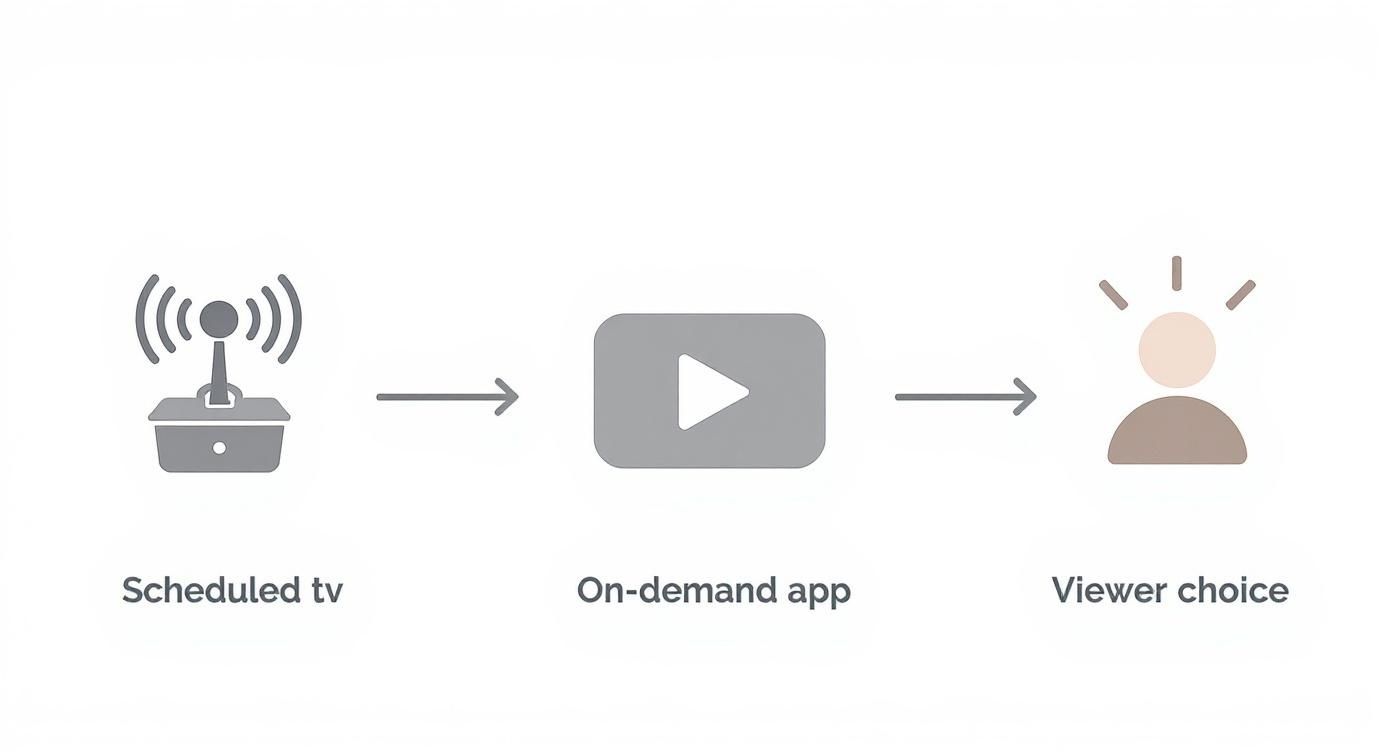
As you can see, technology has wrestled control away from the broadcasters and handed it directly to us. We now decide what to watch and when to watch it.
The Journey of a Video File
When a studio uploads a new movie to a streaming service, it triggers a surprisingly complex technical journey. This whole process is engineered for one purpose: to make sure you get a smooth, buffer-free picture, whether you’re on a 4K TV with fiber internet or a smartphone with a shaky connection.
- Ingestion and Storage: It starts with a single, massive, high-quality video file being uploaded to secure cloud storage. This is the “master copy” before it gets prepared for its worldwide debut.
- Transcoding: Next, that master file is converted into many different versions. This is a critical step called transcoding, where the platform creates multiple resolutions (480p, 720p, 1080p, 4K) and formats. Each one is tailored for different devices and internet speeds. We have a great article that explains what video transcoding is in more detail.
- Content Delivery: These newly created versions of the video are then copied and distributed across a Content Delivery Network (CDN).
Think of a CDN as a global chain of video libraries. Instead of everyone in the world trying to borrow a movie from one single library in, say, Virginia, the CDN puts copies in local “branches” all over the planet. This drastically cuts down on loading times and is the secret weapon against buffering.
Frontend and Backend Harmony
For everything to work, the frontend and backend need to be in constant communication. When you hit play, your app (the frontend) instantly sends a request to the backend.
The backend quickly verifies who you are, checks your subscription, and then tells the nearest CDN server to start sending the best possible video file for your specific device and current internet speed. It’s this seamless, split-second conversation that makes a great video on demand application feel so effortless and keeps you glued to the screen.
Choosing Your Architecture and Monetization Strategy
Before you write a single line of code for your VOD app, two crucial decisions will shape its entire future. First, you have to nail down the technical architecture—the very blueprint of your platform. Second, you need to figure out how you’re actually going to make money from your content.
These aren’t separate choices; they’re completely intertwined. A sprawling, feature-heavy platform designed for a global subscription audience will need a very different technical foundation than a simple app selling individual courses. Getting this right from day one is the difference between smooth sailing and a world of technical debt and headaches down the road.
Selecting the Right Technical Foundation
Think of your app’s architecture as the foundation of a house. You can go with a monolithic approach, where everything is built into one big, interconnected unit. This can be faster to get off the ground, but as you grow, making a small change in one area can risk breaking something else entirely. It quickly becomes cumbersome.
The more modern, flexible alternative is a microservices architecture. Here, you break the application down into a collection of smaller, independent services that talk to each other—one for user logins, another for video processing, a third for recommendations, and so on. This approach gives you incredible flexibility. You can update, scale, or even replace one service without disrupting the entire system.
This is where a powerful video API becomes your best friend, handling the heavy lifting of transcoding and global delivery. For a deeper dive on the delivery side, check out our guide on choosing the best CDN for video streaming.
Key Takeaway: While a monolithic build might feel like a shortcut for a small project, a microservices approach is built for the long haul. It offers the scalability and agility that most serious VOD platforms need to thrive.
Monetization Models: How You’ll Get Paid
With your technical plan in place, the next big question is a simple one: how will this thing make money? In the VOD world, it almost always comes down to one of three core models. Each one works best for different kinds of content and different audiences.
The undisputed champion of the streaming era is Subscription Video on Demand (SVoD). This model is all about recurring revenue, and its growth has been massive. The global SVoD market hit a value of USD 95.50 billion in 2024 and is on track to climb to USD 165.45 billion by 2030, growing at a 9.6% compound annual rate. Its power lies in offering subscribers an all-you-can-eat buffet of content for a flat monthly or annual fee, which is a fantastic way to build a loyal audience. If you want to see just how big this market is, you can dig into the data on SVoD’s global market expansion.
Let’s break down how the big three models stack up against each other.
Comparison of VOD Monetization Models
The table below offers a quick look at the three main ways to monetize your VOD application, highlighting what makes each one tick and where it shines.
| Model | Description | Best For | Pros | Cons |
|---|---|---|---|---|
| SVoD (Subscription) | Users pay a recurring fee (monthly/annually) for unlimited access to a content library. | Large, frequently updated libraries like TV series, movie catalogs, or ongoing course collections. | Predictable, recurring revenue; high user retention and loyalty. | Requires a constant stream of new content to prevent churn; high initial library cost. |
| TVoD (Transactional) | Users pay on a per-view basis, either renting content for a short time or buying it to own forever. | Premium, exclusive content like new movie releases, major sporting events, or high-value masterclasses. | Higher revenue per transaction; captures viewers unwilling to subscribe. | Unpredictable revenue stream; requires strong marketing for each individual piece of content. |
| AVoD (Ad-Supported) | Content is offered for free to viewers, with the platform generating revenue from running ads. | Broad-appeal content designed to attract the largest possible audience, like news or viral clips. | Low barrier to entry for viewers; potential for massive audience reach. | Lower revenue per user; can be intrusive and requires a large audience to be profitable. |
So, which path is right for you? It really boils down to your content and your audience. You don’t have to stick to just one, either. Many of the most successful platforms use a hybrid model, like offering a subscription library but also selling premium new releases on a transactional basis. The key is to match your monetization strategy to the value you’re providing.
Must-Have Features for Engaging Viewers
In a market flooded with streaming services, the features you build into your video on demand application are what will make or break it. A slick interface is just the starting point. What really hooks viewers and turns them into loyal subscribers is a smart mix of features that make watching feel personal, easy, and completely seamless. It’s about figuring out what your audience wants, sometimes even before they do.
This kind of personalization is the foundation of any successful modern streaming platform. It shifts your service from being a simple library of content into an active, curated experience for each user. The aim is to make every viewer feel like the platform was designed specifically for them—a powerful strategy that boosts watch time and keeps them coming back.
Creating a Personalized Viewer Journey
The first step toward building that loyalty is making every user feel understood. This comes down to features that learn and adapt to their tastes, creating a unique content world for every single person. The stakes are high; the global video streaming subscriber base is projected to reach 1.4 billion users by 2025. To get a piece of that pie, you have to offer more than just a big catalog. You need to guide users to content they’ll love. You can learn more about the growth of the VOD subscription market from recent studies.
Key features for personalization include:
- AI-Powered Recommendations: This is your app’s personal concierge. The algorithm looks at what a user has watched, what they’ve rated, and even when they watch, then suggests other movies or shows they’re almost certain to enjoy.
- Robust User Profiles: This is a must for any shared or family account. It gives each person their own watchlist, viewing history, and unique recommendations. No more “My Little Pony” suggestions cluttering up a horror fan’s feed.
- Customizable Watchlists: A simple but essential feature. It lets users save titles for later, giving them a compelling reason to open the app again and ensuring they always have something queued up.
Ensuring Seamless Accessibility and Convenience
Beyond making it personal, the best VOD apps get rid of any and all friction between the viewer and their content. Convenience is everything. Features that fit a modern, mobile lifestyle aren’t just nice-to-haves anymore; they’re absolute requirements.
A great video on demand application doesn’t just offer content; it offers content on the viewer’s terms. It fits into their life, not the other way around, making the experience feel effortless and indispensable.
This means thinking about how and where your audience is watching. Someone might start an episode on their TV, pick it up on their tablet during the morning commute, and finish it on their phone. Your application has to make that journey feel like one continuous experience.
Essential convenience features are:
- Offline Viewing: The ability to download videos is a game-changer for anyone who travels, commutes, or just has spotty Wi-Fi. It guarantees they can access your library from anywhere.
- Multi-Device Synchronization: If a user hits pause on one device, they should be able to resume from that exact same spot on another. This kind of continuity is what separates a good service from a great one.
- Intuitive Search and Filtering: A fast, powerful search function with smart filters (genre, actor, release year, etc.) is non-negotiable. It helps users find what they want in a massive library without getting frustrated and giving up.
Integrating Live Events Into Your VoD Platform
A deep library of on-demand content is a great start, but it’s no longer enough to truly stand out. The real magic happens when you blend the convenience of VoD with the raw, can’t-miss energy of live events. This hybrid approach turns your platform from a simple media library into a dynamic, community-driven destination.

Think of it this way: your VoD catalog is like a fantastic movie collection, always there for your audience. But adding live events is like hosting an exclusive premiere with the cast and crew. The pre-recorded films are the reliable draw, but the live events create a sense of urgency and a shared experience that a static library just can’t match. A modern video on demand application can pull this off by building live streaming capabilities directly into its existing framework.
This simple addition creates powerful “appointment viewing” moments. Suddenly, you’re giving users a reason to log on at a specific time for a live concert, a crucial sports match, an expert webinar, or an interactive Q&A. It’s a strategic play that adds a real-time, engaging layer to your entire service.
The Business Case for Going Live
Bringing live functionality into the mix isn’t just about bolting on another feature; it’s about unlocking entirely new ways to engage your audience and drive revenue. The immediacy of a live broadcast fosters a genuine sense of community. Your viewers stop being passive consumers and start feeling like they’re part of something exclusive.
This shift can have a real impact on your bottom line. Live events open the door to monetization models that don’t always fit neatly into a standard VoD setup, like pay-per-view (PPV) for a championship fight or a one-off virtual concert. These can run right alongside your existing subscription or ad-supported models, creating a new income stream.
By combining on-demand archives with live broadcasts, you create a more complete media ecosystem. This strategy not only retains existing subscribers by offering more value but also attracts new audiences who are drawn in by the allure of exclusive, real-time content.
And the best part? The content doesn’t just vanish after the event ends. Once the stream is over, you can add the recording right into your VoD library. Just like that, you’ve created a valuable new asset that will continue to generate views and engagement long after the live broadcast is over.
How to Integrate Live Streaming Functionality
Adding live capabilities to your video on demand application might sound daunting, but today’s tools have made the process much more straightforward. The secret is using a powerful video API to handle all the technical heavy lifting—ingestion, transcoding, and delivery.
A service like LiveAPI provides the backend infrastructure needed to manage live feeds from start to finish. Instead of trying to build this incredibly complex system from the ground up, your developers can simply integrate the API to manage the entire workflow. This frees you up to focus on what really matters: creating a fantastic user experience.
Generally, the process breaks down into a few key steps:
- Setup the Live Stream: The broadcaster uses encoding software to send a single, high-quality video feed to the API.
- Real-Time Transcoding: The platform instantly processes that feed, creating multiple versions at different quality levels to suit any device or internet connection.
- Global Delivery: These streams are then pushed out through a Content Delivery Network (CDN) to ensure a smooth, buffer-free experience for viewers anywhere in the world.
- Playback on Your App: Your application’s video player simply pulls in the live stream, allowing users to tune in with a click.
This entire workflow is built for scale and reliability. If you’re looking to get a better handle on the basics, our guide on how to stream live video is a great place to start. By adding this functionality, your VoD platform evolves into a far more versatile and competitive service.
Common Questions About Building a VoD App
So, you’re thinking about building a video on demand app? That’s exciting, but it also opens up a whole can of worms. Questions about budget, legal issues, and technical headaches are probably already swirling around. Let’s tackle some of the most common ones head-on to give you a clearer path forward.
First up, the big one everyone asks: what’s this going to cost me?
How Much Does It Cost to Build a VoD App?
There’s no single price tag for a video streaming app—the cost can swing wildly. If you’re just dipping your toes in the water, a simple Minimum Viable Product (MVP) with the core features for a single platform (say, just a web app or an iOS app) could land somewhere in the $25,000 to $50,000 range. An MVP is a great way to test the waters and see if your idea has legs without betting the farm.
But if you’re aiming to build a full-blown, multi-platform experience that can go toe-to-toe with the big names, you’re looking at a much bigger investment, easily climbing into the hundreds of thousands.
What makes the price jump so much? It really boils down to a few key things:
- Custom UI/UX Design: A slick, custom-designed interface feels great to use, but it costs a lot more than slapping a pre-made template on your app.
- Feature Complexity: The more bells and whistles you add, the higher the cost. Things like AI-driven recommendations, offline downloads, or interactive video elements all add serious development hours.
- Backend Infrastructure: The engine under the hood is a huge part of the cost. A complex server setup with multiple databases and APIs is a major line item.
- Ongoing Expenses: Remember, the costs don’t stop at launch. You’ll have recurring bills for content hosting, CDN bandwidth, and the maintenance needed to keep everything running smoothly.
What Is the Difference Between VoD and OTT?
You’ll hear the terms VoD (Video on Demand) and OTT (Over-The-Top) thrown around a lot, sometimes as if they mean the same thing. They don’t. The easiest way to think about it is that OTT is the “how,” and VoD is the “what.”
OTT is simply the delivery method. It means any video content streamed directly to viewers over the internet, completely bypassing traditional cable or satellite boxes.
VoD, on the other hand, is a type of OTT service. It’s the one that lets users pick exactly what they want to watch, whenever they want to watch it.
In short, all VoD services are delivered via OTT, but not every OTT service is VoD. For instance, a service that streams live TV channels over the internet is an OTT service, but it’s not on-demand because you’re watching a scheduled broadcast.
How Do I Legally Acquire Content for My Platform?
Your platform is nothing without content, and getting it the right way is absolutely critical. You have three main routes you can take:
- License Existing Content: This means striking deals with production studios or distributors to get the rights to stream their movies and TV shows. It can get pricey, and the contracts are often tangled with complexities like geographical viewing restrictions.
- Produce Original Content: Think Netflix Originals. Creating your own exclusive content is a fantastic way to stand out and gives you complete control. It demands a serious upfront investment in production, but it can be a game-changer.
- Use Public Domain Content: This is the most budget-friendly option. It involves using older films, documentaries, or shows where the copyright has expired. While cheap, it might not be the biggest draw for a modern audience.
What Are the Main Technical Challenges to Overcome?
Running a smooth VoD service is a constant battle against a few key technical demons. First, there’s scalability. Your infrastructure has to be ready to handle a massive surge in traffic when you drop a popular new movie—the last thing you want is for your app to crash on opening night.
Another huge one is video transcoding. This is the process of converting your master video files into a bunch of different formats and quality levels. It’s essential for making sure your content plays perfectly on any device, from a 4K smart TV to a smartphone on a shaky 3G connection.
Finally, you can’t overlook security. You need rock-solid DRM (Digital Rights Management) to stop people from pirating your content, plus robust systems to protect your users’ personal data and payment details.
Ready to sidestep the headaches of building complex video infrastructure from the ground up? LiveAPI offers a powerful, developer-first solution for both live and on-demand video streaming. You can integrate our robust APIs to take care of the heavy lifting—like transcoding, delivery, and analytics—so you can pour your energy into creating an amazing user experience. Launch your video application with LiveAPI today.