The whole AVOD vs. SVOD debate really boils down to a single question: do you want to make money from advertisers or from your audience? Advertising Video on Demand (AVOD) lets you offer content for free, supported by ads, while Subscription Video on Demand (SVOD) locks content behind a paid subscription for an ad-free experience.
It’s a fundamental choice. Are you aiming for the largest possible audience, or are you building a dedicated community willing to pay for premium content? The answer shapes everything that follows.
Understanding AVOD and SVOD Monetization
At its core, picking between AVOD and SVOD is about defining the value exchange with your viewers. Each model offers a completely different path to profitability, influencing your content decisions, marketing strategy, and even your tech stack.
What is AVOD?
With AVOD, the model is simple and familiar: viewers get free access to content in exchange for watching advertisements. It’s basically the broadcast television model, just delivered online.
This approach is a numbers game. The main objective is to attract as many viewers as possible to generate a high volume of ad impressions. Think of platforms like YouTube, Pluto TV, or the free tier of Peacock. They cast a wide net with massive content libraries, removing the cost barrier to pull in a huge audience. For businesses looking for rapid market penetration, AVOD is often the path of least resistance.
What is SVOD?
SVOD turns that model on its head. Here, the revenue comes straight from your viewers. They pay a recurring fee—usually monthly or annually—to access your content library without interruptions.
This is the world of Netflix, Disney+, and Hulu. Their entire business is built on creating or acquiring exclusive, high-quality content that feels indispensable to subscribers. The relationship with the user is direct and personal. Success isn’t just about getting people to sign up; it’s about keeping them subscribed month after month. You can check out our guide on top video on demand platforms to see more real-world examples.
The global video streaming market, with its 1.4 billion users worldwide in 2024, shows there’s plenty of room for both. Titans like Netflix command a massive 22% of the U.S. SVOD market, while AVOD platforms are booming—YouTube’s advertising revenue alone is expected to hit $72.1 billion by 2027.
Key Takeaway: AVOD monetizes eyeballs through ads, making it a game of scale. SVOD monetizes loyalty through subscriptions, making it a game of value.
Here’s a head-to-head comparison of their core differences.
| Feature | AVOD (Advertising-Based) | SVOD (Subscription-Based) |
|---|---|---|
| Primary Revenue Source | Ad Placements | Recurring User Subscriptions |
| Audience Reach | Maximum; no cost barrier | Limited to paying subscribers |
| Content Strategy | Broad appeal to attract high viewership | Exclusive, premium, and original content |
| Financial Predictability | Variable; depends on ad market | High; based on MRR and churn rates |
| Key Business Metric | Ad Impressions & Fill Rate | Subscriber Growth & CLV |
Revenue Streams and Financial Health: A Tale of Two Models
When you get down to the brass tacks, the financial engines powering AVOD and SVOD platforms couldn’t be more different. This isn’t just a minor detail—it shapes everything from how they buy content to how they plan for the future. Looking at the AVOD vs SVOD financial models is like comparing a steady, predictable salary with a commission-based income; both can be lucrative, but they come with entirely different pressures and rewards.
SVOD is all about predictable, recurring revenue. That consistency is its superpower, making it much easier to forecast budgets and make big strategic bets. Of course, that stability is always one click away from being threatened by customer churn.
The Predictability of SVOD Subscriptions
For a subscription service, the health of the business boils down to a few core numbers that tell you if the recurring revenue model is actually working.
- Monthly Recurring Revenue (MRR): This is the heartbeat of any SVOD platform. It’s a clear, reliable snapshot of the cash coming in each month, which makes planning for new shows, marketing campaigns, and operational costs a whole lot simpler.
- Customer Lifetime Value (CLV): This number tells you how much a single subscriber is worth over the entire time they stick around. A healthy CLV means you have a loyal audience that sees real value in what you offer, which in turn justifies spending more to bring new people in the door.
- Churn Rate: This is the silent killer. It’s the percentage of subscribers who hit the “cancel” button in a given month. Even a tiny uptick in churn can wreak havoc on your MRR and long-term financial stability, which is why keeping subscribers happy is priority number one.
The SVOD game demands a massive upfront investment in exclusive, must-see content just to get people to sign up. It creates a high-stakes pressure cooker where you have to constantly prove your worth to keep subscribers from getting bored and wandering off.
The core financial challenge for SVOD is a balancing act: you have to spend a fortune on acquiring and producing top-tier content, all while keeping your subscription price competitive enough to attract users. You only win if your Customer Lifetime Value is significantly higher than what it costs you to get and keep that customer.
The Volatility of AVOD Advertising
Flip the coin, and you have AVOD, which operates in a much more wild, unpredictable financial world. Here, your revenue is hitched directly to the whims of the advertising market, meaning your success can be influenced by factors completely out of your control.
An AVOD service lives and dies by its ability to sell ad space. You’re not counting subscribers; you’re counting eyeballs and ad performance. This means a totally different set of metrics keep you up at night.
- CPM (Cost Per Mille): This is what an advertiser pays for every thousand times their ad is shown. CPMs can swing wildly depending on who’s watching, what they’re watching, and even what time of year it is.
- Fill Rate: This is the percentage of your available ad slots that you actually manage to sell. A low fill rate is just leaving money on the table, plain and simple.
- Seasonality: The ad market is notoriously seasonal. Revenue can spike during the Q4 holiday rush and then fall off a cliff in January. Managing these peaks and valleys in cash flow is a constant challenge.
This reliance on ad dollars introduces a level of financial volatility that SVOD services just don’t have to deal with. An economic downturn can cause advertisers to pull back their spending almost overnight, gutting an AVOD platform’s revenue.
A Head-to-Head Financial Comparison
To really see the contrast, let’s put the core financial DNA of each model side-by-side. It lays bare the unique pressures and advantages that define the AVOD vs SVOD debate.
| Financial Aspect | SVOD (Subscription-Based) | AVOD (Advertising-Based) |
|---|---|---|
| Revenue Predictability | High. Built on a stable subscriber base and predictable MRR, which allows for solid long-term financial planning. | Low to Medium. Tied to the ebb and flow of ad markets, CPM rates, and seasonal demand, often leading to lumpy quarterly earnings. |
| Primary Scalability Driver | Subscriber Growth. Scaling means convincing more people to pay, which usually requires expensive content and aggressive marketing. | Audience Size. Scaling is all about growing total viewership and ad impressions. The free price point makes it easier to attract a mass audience. |
| Financial Pressures | High Churn and Content Costs. The relentless pressure to create premium content to justify the subscription fee and keep users from canceling. | Ad Market Volatility. You’re exposed to economic slumps, shifts in advertiser budgets, and the performance of your ad-tech stack. |
| Cash Flow Cycle | Consistent. Monthly and annual payments create a smooth, predictable stream of cash throughout the year. | Cyclical. Revenue often mirrors seasonal ad trends, creating significant peaks and troughs that need careful financial management. |
Ultimately, choosing a model comes down to your company’s appetite for risk and its overarching goals. SVOD offers a stable, defensible business but requires deep pockets for premium content. AVOD opens the door to massive audience growth and monetization at scale, but it means learning to ride the unpredictable waves of the advertising world.
How You Win (And Keep) Your Audience
Your choice between AVOD and SVOD isn’t just a revenue decision; it fundamentally shapes how you find and hold onto an audience. Each model dictates a completely different approach to building a relationship with your viewers. It boils down to a classic trade-off: the wide-net, low-friction appeal of AVOD versus the high-value, loyalty-driven world of SVOD.
The AVOD Approach: Go Big or Go Home
The number one weapon in the AVOD arsenal is simple: it’s free. By tearing down the biggest barrier to entry—cost—platforms can cast an incredibly wide net and pull in a massive user base almost overnight. The entire strategy hinges on getting as many eyeballs as possible in front of the screen.
But here’s the catch. That strength in acquisition is a weakness in retention. When viewers have no skin in the game, loyalty is paper-thin. They’ll put up with ads for free content, but only to a point. If you hit them with too many ads or ads that are completely irrelevant, they’re gone in a click.
To make it work, successful AVOD platforms have mastered a delicate dance. They have to keep the ad revenue flowing without torpedoing the user experience.
Here’s how they do it:
- A Massive Library: You need an ocean of content. By offering a huge and diverse catalog, you give people a reason to come back. Services like Tubi and Pluto TV are prime examples—there’s always something new to discover.
- Zero Friction: The sign-up process should be optional or ridiculously simple. Get people watching content within seconds of landing on your platform.
- Smarter Ads: Leveraging data to serve up relevant ads is non-negotiable. An ad for something a viewer actually cares about feels less like an interruption and more like a useful suggestion.
This image really drives home the financial tug-of-war that dictates these strategies.
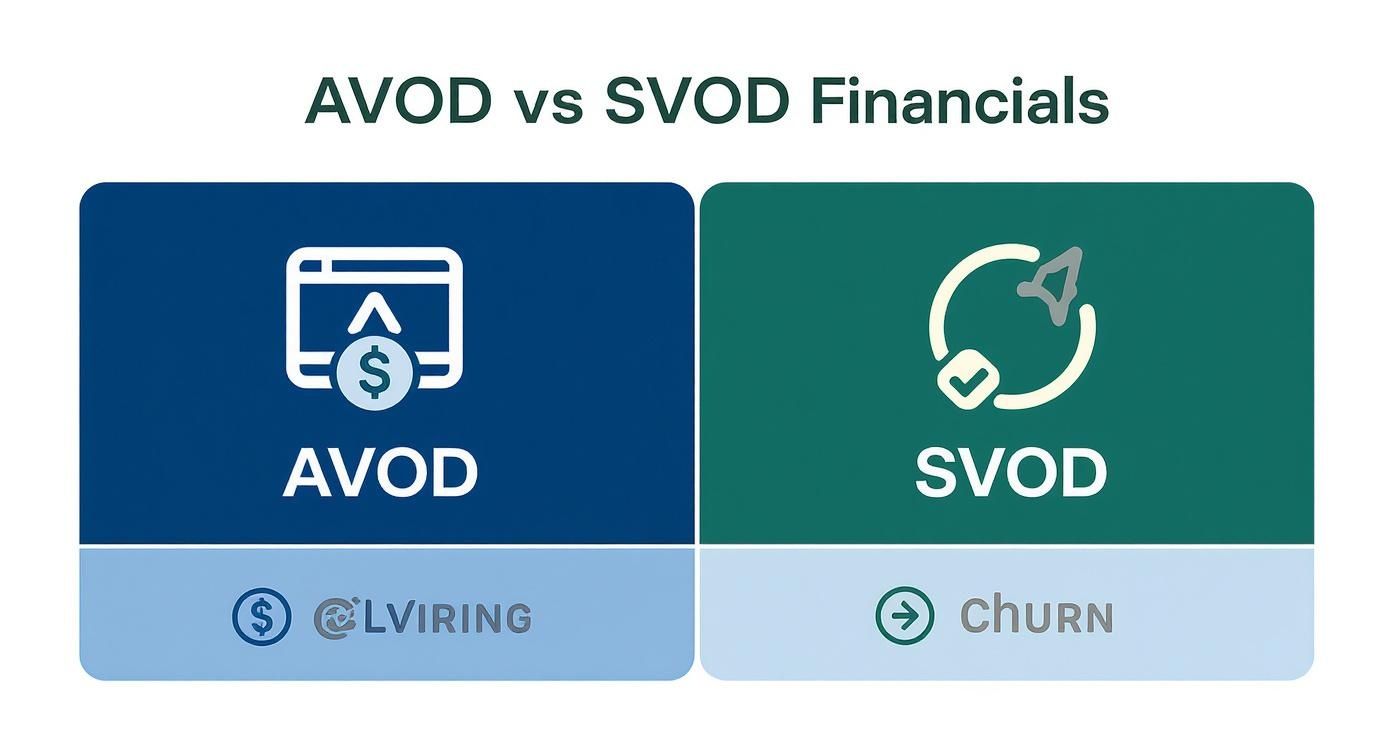
As you can see, AVOD is all about monetizing a huge, loosely-committed audience. SVOD, on the other hand, is built to extract maximum lifetime value from a smaller, but deeply invested, subscriber base.
The SVOD Playbook: Earning Your Keep
SVOD platforms play an entirely different game. They’re asking for your credit card details every month, so their pitch has to be compelling. They aren’t just selling access to a library; they’re selling a premium, can’t-miss experience.
For SVOD services, getting a new subscriber is just the first date. Retention is the entire relationship. You have to make your platform so indispensable that the thought of canceling feels like a mistake.
This model earns its price tag with two things: exclusive, high-budget content and a flawless, ad-free environment. Think of the cultural weight of a Netflix original or the exclusive pull of the Marvel universe on Disney+. This “content moat” is what gets people to sign up in the first place.
Once they’re in, the focus pivots entirely to keeping them happy. SVOD services pour resources into:
- Must-See Exclusives: A constant pipeline of original shows and movies that you simply can’t get anywhere else is the lifeblood of retention.
- Deep Personalization: Sophisticated recommendation engines that truly get the viewer make the service feel curated and essential.
- A Flawless UX: The interface has to be clean, intuitive, and completely ad-free. The experience itself is part of the product.
Of course, the technical side has to be perfect, too—buffering is a deal-breaker. For anyone building a service, knowing how to stream live video without a hitch is a core skill needed to deliver on that premium promise.
AVOD vs SVOD User Engagement Strategies
This table lays out the fundamental differences in how each model approaches the user. It’s not just about ads vs. no ads; it’s a philosophical split in how you build and maintain your audience.
| Strategy | AVOD (Advertising-Based) | SVOD (Subscription-Based) |
|---|---|---|
| Why They Sign Up | It’s free. They get access to a massive library with no commitment. | They want exclusive, high-quality originals and a premium, ad-free experience. |
| How You Keep Them | Constantly refreshing the library and making the ad experience tolerable, even useful. | Consistently delivering must-watch content and powerful personalization. |
| The Relationship | Transactional. Viewers trade their time and attention for free entertainment. | Relational. Subscribers build loyalty based on perceived value and brand affinity. |
| Why They Leave | The ad load becomes unbearable, the content gets stale, or discovery is a pain. | A price hike, a drought of new content, or a more compelling competitor. |
In the end, it’s a clear divide. AVOD grabs users with accessibility, while SVOD wins them with exclusivity. Their retention tactics follow the same logic: AVOD works to keep the free experience from becoming annoying, while SVOD has to continuously prove it’s worth the money.
Comparing Technical Infrastructure and Delivery
Look under the hood of any streaming service, and you’ll find a complex web of technology that defines the entire user experience. In the AVOD vs SVOD debate, the business model you choose has massive implications for your tech stack. What a free, ad-supported service needs is fundamentally different from the requirements of a premium subscription platform.
The core technical mission for each is distinct. For AVOD, it’s all about flawless ad delivery at immense scale. For SVOD, the game is protecting premium content and delivering a perfect, uninterrupted experience that people are happy to pay for every month.
The Ad-Tech Engine Powering AVOD
Think of an AVOD platform less as a video service and more as a high-performance advertising machine. The content is the draw, but the ad-tech stack is the engine that actually generates revenue. Your success lives or dies on your ability to deliver ads reliably without making viewers click away in frustration.
This means you have to get a few key pieces right:
- Server-Side Ad Insertion (SSAI): This is the modern standard for a reason. Instead of the user’s device fetching ads separately (client-side), SSAI stitches ads directly into the video stream on the server. The result is a smooth, TV-like transition that sidesteps most ad blockers—a major threat to AVOD revenue.
- VAST/VPAID Compliance: The Video Ad Serving Template (VAST) and Video Player Ad-Serving Interface Definition (VPAID) are the common languages of digital video advertising. Without strict compliance, your player can’t talk to ad servers, which means you can’t request, deliver, or track ads from different networks. In short, no compliance, no money.
- Real-Time Bidding (RTB) Integrations: To get the most value out of every ad slot, you need to connect to ad exchanges where inventory is sold in real-time auctions. This demands a low-latency infrastructure that can handle a firehose of bid requests every single second.
The technical priority for AVOD is simple: build an incredibly robust pipeline that serves the right ad to the right person, at the right time, without fail.
The Security and Quality Stack of SVOD
When you’re selling a premium experience, your technology has to live up to the promise. With SVOD, the focus shifts entirely from advertising to content protection and flawless delivery quality. Subscribers are paying for perfection, and any technical hiccup can send them straight to the “cancel subscription” button.
The foundational pillars of a strong SVOD tech stack include:
- Digital Rights Management (DRM): Protecting your high-value, exclusive content is non-negotiable. DRM technologies like Google Widevine, Apple FairPlay, and Microsoft PlayReady are essential for preventing piracy. To reach everyone on every device, a multi-DRM strategy is table stakes. If you’re building a platform, understanding the nuances of DRM for video is a critical first step.
- Secure Payment Gateways: Revenue comes directly from your users, so integrating with trusted, secure payment processors like Stripe or Braintree is day-one work. The system must handle recurring billing, trials, and subscription management without a single glitch.
- Superior Adaptive Bitrate (ABR) Streaming: SVOD subscribers have zero tolerance for buffering. A finely tuned ABR streaming setup is vital for dynamically adjusting video quality in real-time based on a viewer’s connection speed, ensuring a consistently smooth playback.
The best technology in an SVOD service is the technology you never notice. The DRM, payments, and streaming protocols should all work so seamlessly that the only thing a subscriber ever thinks about is the amazing content on their screen.
Shared Infrastructure with Different Priorities
While their core missions diverge, both AVOD and SVOD rely on some of the same foundational tech—they just prioritize different aspects of it.
A Content Delivery Network (CDN), for instance, is crucial for both models. It caches content in servers closer to viewers, slashing latency and speeding up load times. But an SVOD service might pay a premium for a top-tier CDN partner to guarantee that premium, instant-on feel. An AVOD platform, while still needing great CDN performance, might prioritize a provider that has deep, proven integrations with its SSAI vendor.
Ultimately, choosing between AVOD and SVOD forces you to make critical decisions about where to invest your technical time and money. One path leads to mastering the ad-tech ecosystem, while the other demands an obsession with security, quality, and a perfect user experience.
Measuring Success with the Right KPIs

Choosing between AVOD vs SVOD is just the first step. The real challenge is measuring success, and that requires a completely different set of tools and metrics for each model. An AVOD platform lives or dies by its advertising efficiency, while an SVOD service is all about keeping paying subscribers happy.
Applying the wrong Key Performance Indicators (KPIs) can lead you down a dangerous path. If you run an AVOD service, obsessing over subscriber counts is pointless. Likewise, focusing only on raw viewership for an SVOD platform completely misses the financial story. You have to build a performance dashboard that speaks the language of your revenue model.
Core KPIs for AVOD Platforms
Think of an AVOD service as a two-sided marketplace. You’re not just serving viewers; you’re serving advertisers. Your most important KPIs, therefore, need to reflect the health of that advertising ecosystem. Are you delivering enough value to advertisers to keep them coming back?
For any AVOD dashboard, three metrics are absolutely non-negotiable:
- Ad Impressions: This is your foundational metric, counting the total number of times an ad is shown. It’s the raw inventory you have to sell, and your primary goal is to grow it.
- Fill Rate: This KPI tells you what percentage of your ad opportunities were actually filled with a paying ad. A low fill rate is the digital equivalent of empty storefronts—you’re leaving money on the table.
- Video Completion Rate (VCR): This one is crucial. It tracks how many viewers actually watch an ad all the way through. A high VCR sends a powerful signal to advertisers that your audience is engaged, which lets you charge higher ad prices (CPMs).
Ultimately, AVOD success isn’t just about attracting a huge audience; it’s about monetizing their attention effectively. A platform with 10 million moderately engaged viewers can be far more profitable than one with 30 million who immediately skip every ad.
Essential KPIs for SVOD Services
SVOD platforms run on a much more direct financial model. Because of that, their KPIs are laser-focused on the long-term value and loyalty of the subscriber base. Success here is measured in months and years, not individual ad views.
Your entire business revolves around the subscription lifecycle, so you need to track metrics that show both growth and sustainability.
- Subscriber Growth Rate: This shows how quickly you’re adding new paying customers. It’s a key signal of market demand and tells you if your content strategy is hitting the mark.
- Churn Rate: This is the percentage of subscribers who cancel their service each month. It’s arguably the single most important metric for an SVOD platform’s health. A high churn rate will cripple profitability, no matter how fast you grow.
- Customer Lifetime Value (CLV): CLV projects the total revenue you can expect from a single subscriber over their entire relationship with your service. A rising CLV is proof that you’re retaining customers who see real, ongoing value in what you offer.
This table breaks down the core differences in how each model defines success.
| Metric Focus | AVOD (Advertising-Based) | SVOD (Subscription-Based) |
|---|---|---|
| Revenue Driver | Advertising Efficiency. Measured by CPM, Fill Rate, and Ad Impressions. | Subscriber Loyalty. Measured by Churn Rate, CLV, and MRR. |
| Audience Metric | Scale and Engagement. How many people are watching and for how long? | Retention. How many subscribers are staying month after month? |
| Financial Health | Ad Revenue Per User. What is the average value generated from each viewer? | Average Revenue Per User (ARPU). What is the average subscription fee paid? |
By tracking the right KPIs, you get a clear, honest picture of your platform’s performance. It’s what allows you to make smart, informed decisions that strengthen your specific monetization strategy.
The Future of Monetization with Hybrid Models
The old battle lines in the AVOD vs SVOD debate are blurring. We’re seeing the rigid divide between free, ad-supported content and premium, ad-free subscriptions simply melt away. The future isn’t about choosing one or the other; it’s about strategically blending them.
This shift toward hybrid models isn’t happening in a vacuum. It’s a direct answer to a maturing market and viewers who expect more flexibility.
The Strategic Shift to Hybrid Monetization
You can see this playing out with the biggest names in streaming. Established SVOD giants are leading the charge, realizing that a single subscription price just doesn’t work for everyone anymore. By rolling out lower-cost, ad-supported tiers, platforms like Netflix and Disney+ are pulling off a brilliant two-pronged strategy.
First, they’re lowering the barrier to entry. This captures price-sensitive viewers who want the exclusive content but are wary of adding another full-priced monthly bill. Second, they’re tapping into a massive new advertising revenue stream, which breaks their total reliance on subscriber fees.
This isn’t just a defensive move to combat churn; it’s an aggressive play for market expansion. A hybrid model lets a platform make money from two completely different audiences at the same time. The core subscribers happily pay a premium for their uninterrupted viewing, while a new wave of users generates cash through ad views.
It all adds up to a more resilient business. It can better absorb the shock of economic downturns when people start cutting back on subscriptions, and it creates a natural pathway to nudge ad-tier users into becoming full-paying customers later on.
The numbers back this up. In the U.S., major players like Amazon Prime Video and Netflix each have over 20% of the market, but their growth is hitting a plateau. When you see research suggesting a $5 price hike could make 60% of users cancel, you understand why ad-supported tiers are so critical. In fact, 54% of SVOD subscribers now use at least one ad-supported plan. Find out more about how ad-supported tiers are reshaping the SVOD market.
From AVOD to Premium Tiers
The strategy works both ways, too. An AVOD service that has already built a large, dedicated audience is in a prime position to launch a premium SVOD tier. YouTube proved how well this works with YouTube Premium.
This approach leverages an existing user base you’ve spent years building. By offering an ad-free option, exclusive content, or bonus features for a monthly fee, an AVOD platform can add a high-margin revenue stream from its most passionate fans. Best of all, it doesn’t disrupt the free service that attracted everyone in the first place.
The key takeaway: The future of video monetization is flexibility. A hybrid approach allows platforms to serve a wider audience, create multiple revenue streams, and build a more sustainable business that can adapt to shifting consumer behaviors and market pressures.
This move from a simple AVOD vs SVOD choice to a flexible hybrid spectrum is the next evolutionary step for the streaming industry. The platforms that master the blend of advertising and subscriptions will be the ones that win in the years ahead. It’s not about picking a side anymore—it’s about building a smarter, more adaptable monetization engine.
A Few Lingering Questions
Even after diving deep into the technical and strategic differences, a few common questions always pop up when it’s time to choose a monetization model. Let’s tackle them head-on.
Is SVOD or AVOD Better for Niche Content?
For creators with a highly specific audience, SVOD is almost always the smarter play. Think about it: if your content is for a dedicated group—say, people who restore vintage motorcycles or programmers learning advanced quantum computing—that audience is often more than willing to pay for content they can’t get anywhere else.
SVOD lets you build a real community and generate consistent revenue straight from your biggest supporters. Trying to make an AVOD model work with a smaller, niche audience is a tough road, since ad revenue really only pays off at massive scale.
Can I Just Use Both?
Absolutely. In fact, this hybrid approach is what most of the big players are doing now. It’s becoming the new standard for a reason. You can offer a free, ad-supported tier (your AVOD funnel) right alongside a premium, ad-free subscription (your SVOD tier).
This strategy is brilliant because it lets you capture two completely different types of viewers: those who are price-sensitive and don’t mind ads, and those who will gladly pay for a premium experience. You widen your potential audience and build a much more stable, diversified business.
The hybrid model creates a built-in upgrade path. Someone might discover your service through the free tier, get hooked on the content, and eventually decide the ad-free experience and exclusive perks are worth paying for.
What Are the Sneakiest “Hidden Costs” of Running an SVOD Service?
Everyone knows content licensing or creation is the biggest line item, but a few other expenses can really catch you by surprise when launching a subscription service. Security and infrastructure are the usual culprits.
- Multi-DRM Licensing: To protect that premium content you’re charging for, you have to pay ongoing licensing fees for encryption technologies like Google Widevine and Apple FairPlay. These are not optional.
- Payment Processing Fees: Every single time a credit card is charged, payment gateways like Stripe or Braintree take a small percentage. It adds up quickly across thousands of subscribers.
- Real Customer Support: Paying customers expect and deserve fast, helpful support for billing questions or streaming hiccups. That means you need to staff a support team, which is an ongoing operational cost.
These aren’t one-time fees; they’re the persistent operational costs that are critical for keeping your subscribers happy and preventing them from churning out.
Ready to build your own streaming service without the infrastructure headaches? LiveAPI provides a complete solution for developers to integrate high-quality live and on-demand video. Get started today and bring your vision to life at https://liveapi.com.